Quick Answer
A pink ribbon most commonly symbolizes breast cancer awareness, support, hope, and solidarity. However, the exact meaning can vary depending on the context. In breast cancer awareness campaigns, it is widely recognized as an international symbol of support for people affected by breast cancer.
Table of Contents
- 1. What Does a Pink Ribbon Mean?
- 2. The Origin & History of the Pink Ribbon
- 3. Pink Ribbon Symbolism: Meaning & Representation
- 4. What Does the Pink Ribbon Mean for Breast Cancer?
- 5. Does the Shade of Pink Change the Meaning?
- 6. Pink Ribbon in Different Contexts
- 7. Pink Ribbon vs. Other Awareness Ribbon Colors
- 8. Why Are Ribbons Used as Awareness Symbols?
- 9. How Are Pink Ribbons Used Today?
- 10. Controversies: Pinkwashing & Commercialization
- 11. Choosing the Right Pink Ribbon for an Event
- 12. FAQ: Pink Ribbon Meaning
1. What Does a Pink Ribbon Mean?
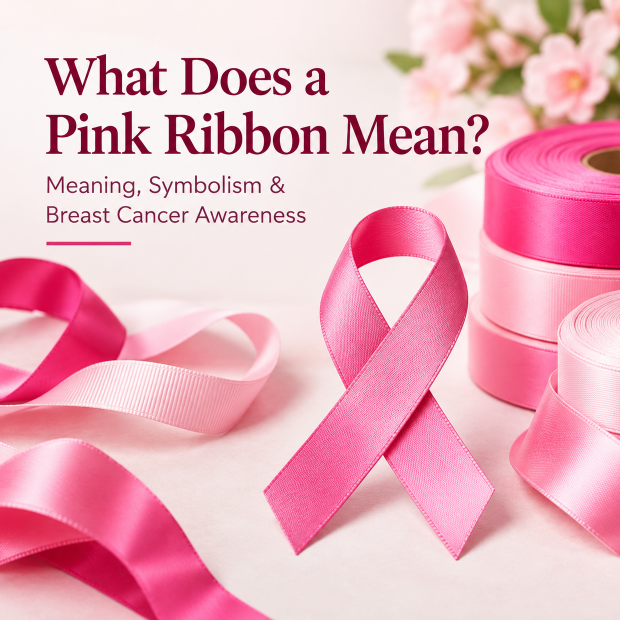
A pink ribbon is widely recognized as a symbol of breast cancer awareness, support, hope, and solidarity. Since the early 1990s, it has become the international emblem for breast cancer awareness campaigns, appearing on everything from lapel pins to product packaging and NFL uniforms.
The pink ribbon communicates several interconnected meanings:
| Meaning | What It Communicates |
|---|---|
| Breast cancer awareness | Raising awareness about breast cancer and early detection |
| Support | Showing support for patients, survivors, and families |
| Solidarity | Demonstrating that people affected by cancer are not alone |
| Hope | Expressing optimism and encouragement |
| Compassion | Showing care and empathy |
| Remembrance | Remembering those lost to breast cancer |
“The pink ribbon symbolizes hope and community for many who’ve been impacted by breast cancer. We are incredibly proud to share the message of breast cancer awareness and support not just during October but every day of the year.”
2. The Origin & History of the Pink Ribbon
The story of the pink ribbon begins not with pink, but with peach. In 1991, Charlotte Haley, a breast cancer survivor whose grandmother, sister, and mother had all battled the disease, began hand-making peach-colored ribbons at her home in Simi Valley, California. She attached them to cards that read:
“The National Cancer Institute annual budget is $1.8 billion, only 5 percent goes for cancer prevention. Help us wake up our legislators and America by wearing this ribbon.”
Haley distributed thousands of these ribbons locally and to prominent women, but when Self magazine and Estée Lauder approached her for a partnership, she declined, believing they were “too corporate”. Self persisted but, on the advice of their lawyers, changed the ribbon’s color from peach to pink.
In October 1992, Estée Lauder launched the first nationwide campaign featuring the pink ribbon, handing out an impressive 1.5 million pink ribbons at their cosmetics counters. This campaign ushered in the pink ribbon as the premier visual symbol of Breast Cancer Awareness Month.
However, the pink ribbon’s journey began even earlier. Susan G. Komen for the Cure® had used the color pink since its inception in 1982. The first Komen Race for the Cure® logo in the mid-1980s featured an abstract female runner outlined with a pink ribbon. In fall 1991, the foundation gave out pink ribbons to every participant in its New York City race. [1]
The ribbon itself as a symbol of cause had precedents: yellow ribbons during the 1979 Iran hostage crisis, when Penney Laingen tied yellow ribbons around trees in her front yard to signal her desire to see her husband home again—and red ribbons adopted by AIDS activists in the late 1980s, when the activist art group Visual AIDS turned the ribbon bright red and sent it onto the national stage during the Tony Awards. The pink ribbon built on this legacy to become one of the most recognized awareness symbols in the world.
According to the World Health Organization, 2.3 million women globally were diagnosed with breast cancer in 2022, with 670,000 deaths, making it the leading cause of cancer-related death in women. In the United States in 2025, an estimated 316,950 new cases of invasive breast cancer are expected among women, with approximately 42,170 deaths. About 1 in 8 women in the U.S. will be diagnosed with breast cancer in her lifetime.
3. Pink Ribbon Symbolism: Meaning & Representation
While the pink ribbon’s core meaning is breast cancer awareness, it carries multiple layers of symbolism that have evolved over three decades:
- 🎀 Awareness — Bringing public attention to breast cancer and the importance of early screening
- 🎀 Support — Showing solidarity with patients, survivors, and families
- 🎀 Hope — Expressing optimism for a future without breast cancer
- 🎀 Community — Creating a visible connection among those affected
- 🎀 Remembrance — Honoring those who have lost their lives to the disease
As one source explains, the pink ribbon represents “fear of breast cancer, hope for the future, and the charitable goodness of people and businesses who publicly support the breast cancer movement. It is intended to evoke solidarity with women who currently have breast cancer.” [2]
Important distinction: The pink ribbon represents awareness and support, not a medical diagnosis or an individual’s cancer status. Wearing a pink ribbon does not mean the wearer has or has had breast cancer.
As the National Breast Cancer Foundation explains: “Over time, the pink ribbon has evolved from a humble peach ribbon handmade by Charlotte Haley to a powerful symbol of breast cancer awareness and support. Its journey from grassroots activism to global recognition showcases a collective effort to raise awareness and support for those facing breast cancer.”
4. What Does the Pink Ribbon Mean for Breast Cancer?
For breast cancer specifically, the pink ribbon is the international symbol of awareness and support. It represents:
- Early detection — Encouraging regular mammograms and self-exams
- Research funding — Supporting scientific advances in treatment and prevention
- Patient support — Providing resources and community for those affected
- Survivorship — Celebrating the strength of breast cancer survivors
Breast Cancer Awareness Month, observed each October, began in 1985 as a partnership between the American Cancer Society and the pharmaceutical division of Imperial Chemical Industries. Former First Lady Betty Ford, herself a breast cancer survivor, helped launch the first week-long event. The goal was to educate women about early detection and promote mammograms as an essential tool in the fight against breast cancer.
Today, the pink ribbon is ubiquitous during October, appearing on NFL uniforms, retail products, and community events nationwide. Pink ribbons, and the color pink in general, identify the wearer or promoter with the breast cancer brand and express moral support for women with breast cancer. [2]
5. Does the Shade of Pink Change the Meaning?
Not necessarily. There is no universal system that assigns an official breast cancer meaning to every shade of pink.
However, some organizations and awareness campaigns have developed specific ribbon variations for different types of breast cancer:
| Ribbon Color | Association |
|---|---|
| Hot pink | Inflammatory breast cancer |
| Teal and pink | Hereditary and gynecologic cancers |
| Pink and blue | Male breast cancer |
| Teal, pink, and green | Metastatic breast cancer |
Beyond these specific associations, different pink shades create different visual impressions based on color psychology, but these are design interpretations rather than official medical meanings.
6. Pink Ribbon in Different Contexts
| Context | Possible Meaning |
|---|---|
| Breast cancer campaign | Breast cancer awareness and support |
| Fundraising event | Support and awareness for breast cancer research |
| Memorial event | Remembrance and support for those affected |
| Gift packaging | Love, care, femininity, or celebration |
| Horse-related use | Often indicates a mare in season (equestrian context) |
| Tree/woods | Trail marking, forestry work, surveying, or land management |
7. Pink Ribbon vs. Other Awareness Ribbon Colors
| Ribbon Color | Common Association |
|---|---|
| Pink | Breast cancer awareness |
| Red | HIV/AIDS awareness, heart disease |
| Gold | Childhood cancer |
| Gray | Brain cancer |
| Orange | Leukemia, kidney cancer |
| Purple | Pancreatic cancer, Alzheimer’s disease |
| Teal | Ovarian cancer, sexual assault awareness |
Important: Awareness ribbon colors are not universally standardized across every organization. Different groups may use the same color for different causes.
8. Why Are Ribbons Used as Awareness Symbols?
Ribbons are effective awareness symbols because they are:
- Easy to wear — Simple to pin on clothing
- Inexpensive — Low cost to produce and distribute
- Highly visible — Easily noticed by others
- Easy to reproduce — Simple to manufacture at scale
- Easy to customize — Can be printed with logos, names, or messages
9. How Are Pink Ribbons Used Today?
Awareness Events
- Breast Cancer Awareness Month (October)
- Charity walks and runs
- Fundraising events
- Community events
Retail and Packaging
- Gift packaging
- Promotional packaging
- Campaign packaging
Custom Printed Ribbons
- Logos and branding
- Campaign names
- Event dates
- Awareness messages
10. Controversies: Pinkwashing & Commercialization
While the pink ribbon has raised unprecedented awareness for breast cancer, it has also attracted significant criticism. The term “pinkwashing” was coined in 2002 by the nonprofit Breast Cancer Action to describe companies that use pink ribbon marketing to promote products while contributing little to the cause—or worse, while manufacturing products that may increase cancer risk.
According to Breast Cancer Action, pinkwashing is “specifically the hypocrisy of companies telling us how much they care about breast cancer while their product or service might increase risk of the disease.”
Notable Examples of Pinkwashing
- Revlon (2003): Partnered with the National Breast Cancer Coalition on a campaign featuring pink ribbons on cosmetics containing long-chain parabens and DMDM hydantoin (a formaldehyde-releasing chemical), both known to increase cancer risk. The company has since removed these ingredients.
- KFC “Buckets for the Cure” (2010): Partnered with Susan G. Komen for the Cure, donating 50 cents per bucket sold. Critics pointed out the contradiction of promoting high-fat, low-nutrition food to raise money for a disease linked to obesity.
- Mike’s Hard Pink Lemonade: An alcoholic product using the pink ribbon symbol, despite alcohol being a known risk factor for breast cancer.
As one academic analysis notes: “Since no corporation has exclusive rights over the pink ribbon, misuse of the ribbon can occur through the marketing of products that can increase breast cancer such as alcohol.”
Critics also argue that wearing a pink ribbon can be a form of “slacktivism”—a low-effort gesture that has no practical positive effect. The Pink Ribbons, Inc. documentary further scrutinizes how some companies use pink ribbon marketing to improve their public image while manufacturing products that may be carcinogenic.
Despite these criticisms, the pink ribbon remains a powerful symbol. The key is for consumers to “Think Before You Pink”—a campaign by Breast Cancer Action that encourages people to ask critical questions about pink ribbon promotions:
- How much of the purchase price actually goes to breast cancer causes?
- Does the company’s product contain ingredients linked to cancer?
- Is the campaign transparent about where funds are directed?
Important Note: Not every pink ribbon campaign is pinkwashing. Many organizations and companies genuinely support breast cancer research and patient services. The key is to research the organization behind the ribbon and understand where donations are going.
11. Choosing the Right Pink Ribbon for an Event
When selecting pink ribbons for an awareness event, consider:
(1)Ribbon Width
- Narrow ribbon — Awareness pins, small bows
- Wide ribbon — Event decoration, packaging
(2)Material
- Grosgrain Ribbon — Structured, durable, ideal for bows and packaging
- Pink Satin Ribbon — Smooth, premium, elegant for awareness events
- Pink Organza Ribbon — Lightweight, decorative, perfect for gift packaging
- Velvet Ribbon — Rich, luxurious, suitable for premium campaigns
(3)Printing Options
- Logo
- Campaign name
- Event date
- Awareness message
12. FAQ: Pink Ribbon Meaning
What does a pink ribbon mean?
A pink ribbon most commonly symbolizes breast cancer awareness, support, hope, and solidarity. Its exact meaning can vary depending on the context.
What does a pink ribbon represent?
The pink ribbon represents awareness, support, remembrance, and encouragement for those affected by breast cancer.
What does a pink ribbon symbolize?
The pink ribbon symbolizes awareness, support, solidarity, hope, and remembrance in the context of breast cancer.
What does wearing a pink ribbon symbolize?
Wearing a pink ribbon symbolizes support for breast cancer awareness and people affected by breast cancer. It does not indicate that the wearer has or has had breast cancer.
Does every pink ribbon represent breast cancer?
Not necessarily. While most commonly associated with breast cancer awareness, its meaning can vary depending on the context, organization, or campaign.
Does the shade of pink change the meaning?
There is no universal system assigning official meanings to every pink shade. Some specific shades have recognized associations (hot pink for inflammatory breast cancer), but these are not standardized across all organizations.
What is pinkwashing?
Pinkwashing is when companies use pink ribbon marketing to promote products while contributing little to breast cancer causes, or while manufacturing products that may increase cancer risk.
What does a pink ribbon on a tree mean?
A pink ribbon on a tree may indicate trail marking, forestry work, land surveying, construction marking, or arborist evaluation. The meaning depends on who placed it.
What does a pink ribbon mean on a horse?
In equestrian contexts, a pink ribbon often alerts others that the horse is a mare in season. It may also indicate support for breast cancer awareness in other contexts.
Important Note About Ribbon Colors
Not every ribbon color has one universally accepted meaning. Awareness organizations, charities, local communities, and events may use colors differently. When a ribbon has a specific cause associated with it, the organization or campaign behind the ribbon is the best source for confirming its meaning.
The pink ribbon means well — it’s bringing awareness to breast cancer and screening exams. But understanding the full context—including potential pinkwashing—is essential for interpreting what any particular ribbon truly represents.
In One Sentence
A pink ribbon is a widely recognized symbol of breast cancer awareness, support, hope, and solidarity, although its exact meaning can vary by context and its use has sparked important debates about commercialization and accountability.
By Jessica Doyle
Health Communications Specialist & Breast Cancer Awareness Advocate
Jessica Doyle has over 8 years of experience in health communications, working with nonprofit organizations to develop educational content on cancer awareness, early detection, and patient support. She holds a Master’s degree in Public Health from the University of North Carolina and has contributed to awareness campaigns recognized by the National Breast Cancer Foundation.
References
Last updated: September 2026