Acetate ribbon is a decorative ribbon made from cellulose acetate, a semi-synthetic fiber derived from wood pulp or cotton fibers. It is known for its smooth, glossy appearance, crisp hand feel, and ability to hold structured bows.
But acetate ribbon is not simply another name for satin ribbon.
That distinction matters more than most buyers realize. Many people searching for “acetate ribbon” on Google are actually looking for homecoming mum ribbon — they just don’t know the material name yet. Others are packaging buyers who have seen “satin acetate” on a supplier’s spec sheet and assumed it was just another way of saying “satin.” Both groups deserve a straight answer.
What Is Acetate Ribbon?
Acetate is a cellulose-based manufactured fiber. It is created through a chemical reaction in which cellulose — a natural polymer found in plant cell walls — is treated with acetic acid or acetic anhydride. The resulting fiber has a natural sheen, good drape, and relatively low moisture absorbency.
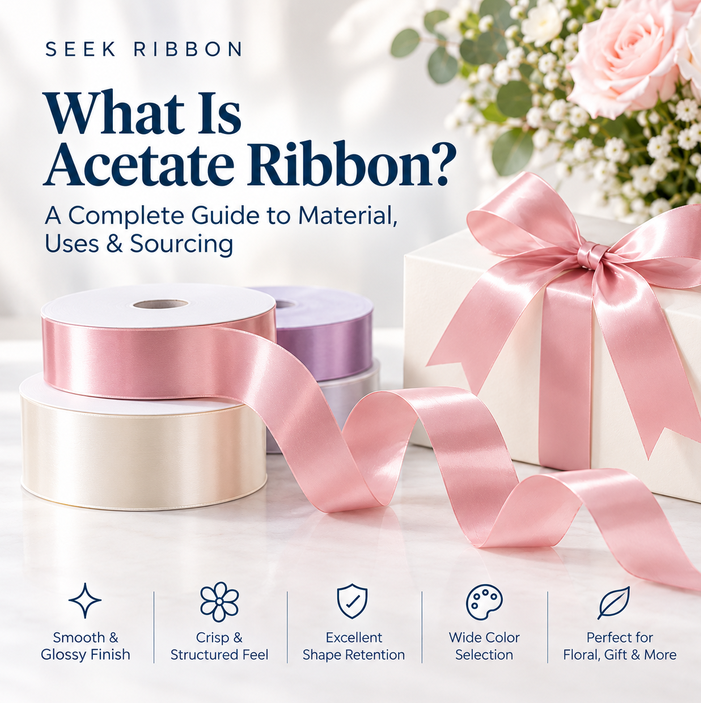
Acetate ribbon, then, is ribbon made from acetate fiber, typically woven in a satin weave that produces a smooth, glossy surface. The combination of acetate fiber and satin weave explains why so many suppliers use interchangeable terms like:
- acetate ribbon
- acetate satin ribbon
- satin acetate ribbon
All three refer to the same material family: a glossy, structured ribbon with a firm hand feel.
The critical distinction is this: satin describes a weave or surface construction, while acetate describes the fiber. A polyester satin ribbon and an acetate satin ribbon may look similar on a shelf, but they behave very differently in application.
What Is Acetate Ribbon Made Of?
| Feature | Acetate Ribbon |
|---|---|
| Main Fiber | Cellulose acetate |
| Fiber Origin | Wood pulp (pine, eucalyptus) or cotton |
| Surface | Smooth, glossy, satin weave |
| Hand Feel | Crisp, firm, structured |
| Edge | Often cut edge, heat-sealed |
| Shape Retention | Excellent |
| Biodegradable | Yes (cellulose-based) |
| Typical Uses | Floral, homecoming mums, gift wrapping, crafts |
One point worth emphasizing for B2B buyers: acetate ≠ polyester. When a supplier lists “satin ribbon” without specifying the fiber, you may be buying polyester, acetate, or a blend. Always confirm fiber composition before placing a bulk order.
Acetate Ribbon vs Satin Ribbon: What’s the Difference?
This is the question that confuses most buyers, so let’s address it directly.
| Feature | Acetate Ribbon | Polyester Satin Ribbon |
|---|---|---|
| Fiber | Cellulose acetate | Polyester |
| Surface | Glossy | Glossy |
| Hand Feel | Crisp / firm | Soft / smooth |
| Shape Holding | Excellent | Moderate |
| Large Bows | Excellent (fold-pinch method) | Good |
| Draping | More structured | More fluid |
| Edge | Cut / heat-sealed | Usually woven edge |
| Biodegradable | Yes | No |
| Common Uses | Homecoming mums, floral, structured bows | Packaging, printing, general decoration |
The practical difference shows up most clearly in how each ribbon ties. Polyester satin ribbon is soft and flowing — it knots easily and drapes naturally. Acetate satin ribbon is stiffer and flatter, more rigid, and stays in place. It is not suitable for tying into knotted bows; instead, large elegant bows are formed using a fold-pinch-and-fan technique.
This is exactly why florists and homecoming mum makers reach for acetate. A polyester satin bow will sag over time. An acetate bow holds its shape through a full day of event wear or a full season of storage.
Why Homecoming Mums Are the Most Important Application for Acetate Ribbon
Homecoming mums are a Texas tradition that has grown into a significant commercial category, and acetate ribbon is the backbone of that industry.
The ribbon used for mum braids and streamers is typically sold as acetate/lustre ribbon, sometimes called “luster” ribbon. Standard mum ribbon widths include:
- 7/8″ (No. 5) — the primary braiding ribbon, sold in 100-yard rolls
- 2½″ — used for streamers, sold in 50-yard rolls
- 1 5/16″ — another common braiding and looping width
The reason acetate dominates this application comes down to performance. Mum ribbon must hold stiff, structured loops that survive being worn for hours. It must resist wilting, fading, and bleeding — critical for outdoor homecoming events where heat and moisture are factors. Acetate’s firm hand and shape retention deliver this.
Professional mum makers buy acetate ribbon in bulk, often on 100-yard spools. If you are sourcing ribbon for this market, the key specification questions are fiber purity (100% acetate vs. blends), stiffness grade, and color consistency across production runs.
What Are the Main Characteristics of Acetate Ribbon?
Smooth and Glossy Appearance
Acetate ribbon has a high natural sheen — it looks like satin because it often is woven in a satin construction. The gloss is inherent to the fiber, not just a surface finish.
Crisp, Structured Feel
This is acetate’s signature quality. The ribbon feels firm and holds its shape when folded or looped. It does not collapse or sag the way softer ribbons can.
Excellent Shape Retention
Acetate ribbon keeps its form over time. This makes it ideal for large bows, floral arrangements, and decorative packaging where the ribbon needs to stay looking intentional.
Heat-Sealed Edges
Many acetate ribbons use a cut-edge construction with heat-sealed edges, which helps reduce fraying. The heat-sealing is possible because cellulose acetate is thermoplastic.
Wide Color Selection
Acetate ribbon is available in a broad range of colors, from standard holiday shades to custom-matched options for branded packaging.
Biodegradable
Because acetate is cellulose-based, it is biodegradable and compostable. Unlike polyester ribbon, it can break down naturally. This is a genuine selling point for brands with sustainability commitments, provided the claim is framed accurately.
What Is Acetate Ribbon Used For?
- Floral Arrangements. Bouquet wrapping, floral bows, wedding flowers, and sympathy arrangements. Florists favor acetate because its structured loops hold their shape through handling and display.
- Homecoming Mums. Braiding, streamers, loops, and decorative accents. This is the single largest commercial application for acetate ribbon in the U.S.
- Gift Wrapping and Retail Packaging. Gift boxes, luxury packaging, and retail displays. Acetate ribbon can give packaging a more structured, decorative appearance without the weight of a heavier material.
- Wedding Decorations. Chair bows, pew bows, aisle decorations, and wedding favor packaging.
- Holiday Decorations. Christmas bows, wreaths, seasonal packaging, and decorative displays.
- Craft Projects. DIY bows, scrapbooking, wreath-making, and decorative projects.
- Event Decorations. Ceremony decorations, gift tables, and event displays.
How to Choose the Right Acetate Ribbon for Your Business
Width
Common acetate ribbon widths range from 3/8″ to 3″, depending on the application. Homecoming mum braids typically use 7/8″, while large bows and floral applications often use 1½″ to 3″. Confirm the specific widths your supplier stocks and whether custom widths are available.
Color
Consider stock colors, seasonal colors, brand colors, and custom color matching. Color consistency across production runs is critical for branded packaging and mum-making at scale.
Roll Length
Standard roll lengths include 10, 25, 50, and 100 yards. Homecoming mum suppliers typically sell 100-yard spools for braiding ribbon and 50-yard rolls for streamer widths.
Edge Finish
Ask: Is it cut edge or woven edge? Is the edge heat-sealed? Cut-edge acetate with heat sealing is standard for most decorative and mum applications.
Material Composition
Do not ask “Is this satin ribbon?” Ask “What is the fiber composition?” This is the single most important question in acetate ribbon sourcing.
Printing Compatibility
Printing performance depends on the acetate construction, surface treatment, and printing method. Some acetate ribbons are suitable for foil stamping and continuous printing; others are not compatible with thermal-transfer processes. Always request a printed sample before committing to a bulk custom order.
Is Acetate Ribbon Eco-Friendly?
Acetate is a cellulose-based manufactured fiber, commonly derived from wood pulp from sustainably sourced pine and eucalyptus trees. Finished acetate ribbon is biodegradable and can be composted.
However, the environmental impact of a finished ribbon depends on the full supply chain: fiber source, manufacturing process, dyes, finishes, packaging, and disposal conditions. A ribbon can be cellulose-based and still carry a significant footprint if produced in an energy-intensive facility or shipped long distances.
For B2B buyers, the responsible approach is to ask your supplier specific questions: Where does the wood pulp come from? Is it FSC-certified? What is the manufacturing energy profile? Avoid vague “eco-friendly” claims and request documentation for any sustainability position you plan to communicate to your customers.
How to Care for Acetate Ribbon
- Store in a cool, dry environment, wrapped to protect from moisture and microorganisms
- Avoid prolonged exposure to moisture
- Avoid excessive heat (acetate is thermoplastic and can deform)
- Do not use high-temperature ironing
- Keep rolls protected from crushing
- Shelf life is long if stored properly — color may fade gradually over years
Acetate Ribbon Wholesale Buying Guide: Supplier Checklist
Before placing a bulk order, ask your supplier:
- What is the exact fiber composition? (100% acetate vs. blend)
- What widths are available? Can you produce custom widths?
- What colors are in stock, and what is the lead time for custom color matching?
- What is the standard roll length? Can you provide custom put-ups?
- What edge finish is used? Is it heat-sealed?
- Can you provide samples for application testing?
- What is the MOQ for stock and custom orders?
- What packaging options are available — rolls, spools, bulk, private label?
- What is the production lead time for repeat orders?
- Is the ribbon suitable for the printing method I plan to use?
FAQs About Acetate Ribbon
What is acetate ribbon?
Acetate ribbon is a decorative ribbon made from cellulose acetate fiber, typically woven in a satin construction. It is known for its glossy appearance, crisp hand feel, and excellent shape retention.
What is acetate ribbon made of?
Cellulose acetate, a semi-synthetic fiber derived from wood pulp or cotton fibers.
Is acetate ribbon the same as satin ribbon?
No. Satin describes a weave; acetate describes a fiber. Acetate ribbon is often woven in a satin weave, but polyester satin ribbon is a different material with different performance characteristics.
Is acetate ribbon good for making bows?
Yes, especially large structured bows. It is stiffer than polyester satin and holds its shape better. However, it is not suitable for tightly knotted bows — use a fold-pinch method instead.
What is acetate ribbon used for?
Homecoming mums, floral arrangements, gift wrapping, wedding decorations, holiday decorations, crafts, and retail packaging.
Is acetate ribbon suitable for floral arrangements?
Yes. Florists prefer it because it holds large, beautiful loops and is water-resistant.
Can acetate ribbon be printed?
Printing compatibility depends on the specific construction and printing method. Some acetate ribbons work well with foil stamping and continuous printing. Always request a printed sample before mass production.
How should acetate ribbon be stored?
In ambient conditions, wrapped to protect from moisture and microorganisms. Avoid heat and direct sunlight.
Looking for Acetate Ribbon for Your Business?
Whether you need acetate ribbon for homecoming mum production, floral packaging, gift wrapping, wedding decoration, or retail applications, the right supplier should be able to answer every question in the checklist above — clearly and specifically.
Request a Sample → Contact Seek Ribbon →