Velvet ribbon is a woven fabric ribbon with a short, dense cut pile on one or both sides, giving it a soft, matte, light-absorbing surface. It is made from polyester, nylon, cotton, rayon, or blends, and is widely used in luxury packaging, fashion trim, wedding décor, and seasonal ornamentation. Velvet ribbon comes in widths from roughly 2 mm to 100 mm; the right width depends on the application, bow size, and packaging format. For B2B buyers, key selection factors include pile density, backing construction, colorfastness, and whether a wired or non-wired edge is required.
What Is Velvet Ribbon?
Velvet ribbon is a narrow woven textile with a cut pile surface — thousands of short, upright fibers that create a plush, three-dimensional face. Unlike satin ribbon, which reflects light with a high sheen, velvet ribbon absorbs light and produces a deep, matte color appearance.
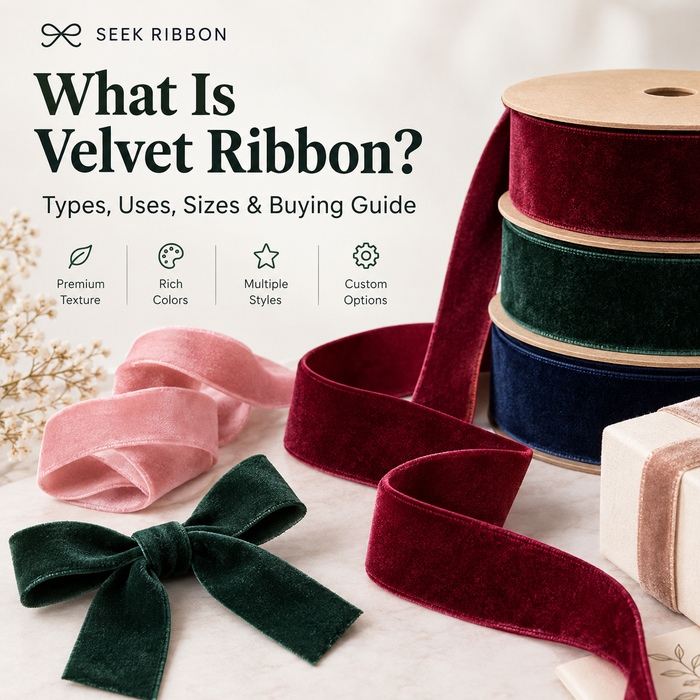
The ribbon is typically woven on narrow-fabric looms, then dyed and finished. The pile may be produced by a warp-pile construction (where pile yarns are woven over wires that are later cut) or by a knitted pile method. Industrial velvet ribbons are commonly made from nylon, polyester, or blends, with cotton and rayon options for more natural or luxurious hand-feel requirements. The Chinese industry standard FZ/T 63019 defines velvet ribbon as woven from nylon or polyester in widths from 2 mm to 100 mm, covering single-face and double-face constructions.
What Does Velvet Ribbon Look and Feel Like?
The defining sensory characteristics of velvet ribbon are:
- Soft pile surface — a cushioned, tactile face that compresses under pressure and slowly recovers
- Plush texture — denser pile produces a more substantial, “squishy” feel; a low-GSM ribbon feels thin and flat by comparison
- Matte / low-sheen appearance — velvet diffuses light rather than reflecting it, which makes colors appear richer and more saturated, particularly under warm or dim lighting
- Soft hand feel — unlike stiff polypropylene or paper ribbons, velvet ribbon drapes and folds naturally
- Rich color appearance — the light-absorbing surface creates depth; a well-dyed velvet ribbon maintains its color intensity in both bright daylight and warm indoor conditions
A practical quality check used by sourcing professionals is the “squish test”: run your thumb against the grain of the pile. On a high-quality velvet ribbon, a visible trail should appear and then slowly disappear as the fibers spring back. If the ribbon feels thin, or if the backing material is visible when the ribbon is bent, the pile density is likely insufficient for premium applications.
What Is Velvet Ribbon Made Of?
| Material | Characteristics | Typical use positioning |
|---|---|---|
| Polyester | Durable, colorfast, consistent dye lot, cost-effective | High-volume packaging, retail gift wrap, seasonal decoration |
| Nylon | Softest hand feel, excellent dyeability, strong pile resilience | Premium bows, fashion trim, hair accessories |
| Cotton | Natural matte appearance, gentle texture | Artisanal packaging, eco-positioned brands |
| Rayon / viscose | Silky, luxurious drape, rich color depth | Bridal, haute couture, luxury gifting |
| Blended fibers | Balances softness, durability, and cost | Custom projects with specific performance targets |
For B2B buyers, pile density is often a more important specification than fiber content alone. Density is sometimes communicated as GSM (grams per square meter) or as a pile-height specification. Higher-density ribbon holds bow structure better and resists flattening during shipping and display.
Types of Velvet Ribbon
Single-Face Velvet Ribbon
Velvet pile on one side only; the reverse side is a flat woven backing, often smooth or slightly textured. This is the most common industrial velvet ribbon construction. It is cost-effective and works well for applications where only one side of the ribbon is visible, such as flat trim, edging, or simple gift-wrap bows.
Double-Face Velvet Ribbon
Velvet pile on both faces. This construction produces a fuller, more luxurious ribbon that remains visually consistent when twisted, folded, or viewed from any angle. Double-face velvet is preferred for high-end packaging, garment sashes, and any application where the ribbon’s reverse may be visible.
Wired Velvet Ribbon
A wire is woven into one or both selvages, allowing the ribbon to hold a shaped bow, a structured loop, or an architectural curve without drooping. Wired velvet is widely used in wreaths, Christmas tree decoration, table arrangements, and retail display. Seek Ribbon currently offers wired velvet ribbon as a product direction. Wired edges add stiffness, so the ribbon does not drape as softly as non-wired velvet; the application should determine whether wired or non-wired is appropriate.
Stretch Velvet Ribbon
Contains elastane or a similar stretch fiber, allowing the ribbon to conform to curved or irregular surfaces without wrinkling. Stretch velvet is used in garment trim, headbands, and close-fitting decorative applications.
Printed Velvet Ribbon
Velvet ribbon with a printed pattern — polka dots, seasonal motifs, brand logos, or custom artwork. Printing on velvet requires careful ink selection because the pile surface can distort fine detail. Digital proofs and physical strike-offs are standard practice before bulk production.
Custom Velvet Ribbon
Velvet ribbon produced to a buyer’s specification: custom width, custom color (Pantone or physical swatch), custom pile height, custom roll length, and custom packaging. This category is covered in more detail in the customization section below.
What Are the Common Velvet Ribbon Sizes?
Standard velvet ribbon widths, with approximate metric equivalents:
| Imperial width | Metric equivalent | Typical application |
|---|---|---|
| 1/4 inch | ~6–7 mm | Fine trim, jewelry packaging, delicate bows |
| 3/8 inch | ~9–10 mm | Gift wrap, small bows, hair accessories |
| 1/2 inch | ~13 mm | General packaging, craft projects |
| 5/8 inch | ~16 mm | Retail gift wrap, invitation bands |
| 1 inch | ~25 mm | Medium bows, garment trim, table décor |
| 1.5 inch | ~38 mm | Statement bows, bouquet wrap, wreath accents |
| 2 inch | ~50 mm | Large retail bows, luxury packaging |
| 2.5 inch | ~63 mm | Seasonal decoration, display bows |
| 3 inch | ~75 mm | Wreath bows, large-format packaging |
| 4 inch | ~100 mm | Oversized decorative bows, event installations |
Width tolerance varies by supplier and construction. For B2B orders, width tolerance should be specified in the RFQ — commonly ±0.5 mm for narrow ribbons and ±1 mm for wider constructions.
The right ribbon width depends on the application, bow size, packaging format, and desired visual effect. A 3/8-inch velvet ribbon may be ideal for a jewelry box pull, while a 2.5-inch wired velvet ribbon may be required for a retail display wreath. Narrower velvet ribbons are typically wound in longer rolls (e.g., 100 yards), while wider and thicker ribbons are often packed in shorter roll lengths (e.g., 50 yards) because the fabric volume per roll increases.
What Is Velvet Ribbon Used For?
Packaging
- Luxury gift boxes — velvet ribbon adds a tactile, premium signal that satin or paper ribbon does not
- Jewelry packaging — commonly used for drawer pulls, pouch ties, and box closures
- Cosmetic packaging — ideal for premium skincare, fragrance, and beauty gift sets
- Boutique packaging — independent retail brands use velvet ribbon to differentiate the unboxing experience
Fashion
- Garments — sashes, waist ties, sleeve trim, and neckline accents
- Accessories — chokers, bag straps, hat bands, and belt detailing
- Hair accessories — bows, headbands, and barrettes
Wedding & Events
- Invitations — velvet ribbon bands and closures for premium invitation suites
- Wedding favors — small velvet bows on favor boxes and bags
- Bouquets — stem wrap for bridal and bridesmaid bouquets
- Table decorations — napkin ties, menu bands, and chair accents
Crafts & DIY
- Bows — both simple knot bows and structured multi-loop bows
- Ornaments — hanging loops and decorative accents
- Decorative projects — scrapbooking, mixed media, and textile art
Holiday & Seasonal Decoration
- Christmas — tree bows, wreath accents, garland ties, and gift wrap
- Halloween — dark-toned velvet ribbon for wreaths and table settings
- Valentine’s Day — red and pink velvet ribbon for packaging and floral arrangements
Velvet Ribbon vs Satin Ribbon
| Feature | Velvet Ribbon | Satin Ribbon |
|---|---|---|
| Surface | Soft, plush cut pile | Smooth, flat woven surface |
| Appearance | Rich, matte, light-absorbing | Shiny, light-reflecting |
| Texture | Soft and tactile; cushioned | Smooth and silky |
| Style | Luxurious, vintage, elegant | Polished, classic, formal |
| Bow structure | Fuller and more textured; holds volume | Smooth and flowing; can appear thinner |
| Weight | Heavier per unit length | Lighter |
| Common uses | Luxury packaging, fashion trim, weddings, seasonal décor | Packaging, gift wrap, branding, lingerie trim |
Satin ribbon is generally finished on one side (single-face satin) or both sides (double-face satin), and its high sheen creates a different visual signal than velvet. For brands positioning around warmth, heritage, or tactile luxury, velvet ribbon is often the stronger choice. For brands positioning around brightness, modernity, or formal elegance, satin may be more appropriate. Many premium packaging programs use both: velvet ribbon for the box closure and satin ribbon for the brand tag.
How to Choose the Right Velvet Ribbon
B2B buyers — brand owners, packaging companies, retailers, wholesalers, and importers — should evaluate velvet ribbon across the following specification categories before requesting a quote:
- Material — polyester for durability and cost; nylon for softness and dyeability; cotton for natural positioning; rayon for luxury drape
- Width — determined by the application, bow size, and packaging format; confirm metric equivalent for international orders
- Color — request Pantone matching or a physical swatch reference; ask for colorfastness data (rubbing fastness grade, light fastness grade) if the ribbon will be exposed to friction, moisture, or UV
- Thickness / Pile density — request GSM or pile-height specification; higher density generally correlates with better bow recovery and a more premium hand feel
- Single-face or double-face — single-face for flat trim and cost-sensitive applications; double-face for applications where the reverse side is visible
- Wired or non-wired — wired for shaped bows and structural décor; non-wired for soft drape and wearable applications
- Roll length — narrower ribbons commonly 100 yards per roll; wider ribbons commonly 50 yards per roll; custom roll lengths available for private-label programs
- Packaging — spool type, carton protection, and whether rolls are individually labeled; velvet ribbon is sensitive to pressure, so spool and carton specifications should be confirmed before bulk shipment
- Customization — see the next section
- Application — always test a physical sample in the actual application before committing to bulk production
For a detailed RFQ checklist, buyers should convert their use case into written specifications covering width tolerance, color tolerance, pile height, MOQ, and test method before approaching suppliers.
Can Velvet Ribbon Be Customized?
Seek Ribbon offers custom velvet ribbon programs for B2B buyers:
- Custom width — from narrow trim widths to wide decorative ribbons; confirm tolerance requirements in the RFQ
- Custom color — Pantone matching or physical swatch matching; custom dye lots available for order volumes that meet MOQ
- Custom printing — brand logos, patterns, and seasonal motifs printed on velvet; digital proof and physical strike-off standard before bulk
- Custom packaging — branded spools, header cards, poly bags, and retail-ready packaging
- Private label — ribbon produced under the buyer’s brand with buyer-specified labeling and packaging
- Custom roll length — 10-yard, 25-yard, 50-yard, 100-yard, or buyer-specified lengths
Custom velvet ribbon development typically requires a written specification and a physical sample approval step before bulk production. For Pantone matching, buyers should provide either a Pantone number or a physical color swatch; suppliers can then produce a lab dip for approval. Color tolerance should be agreed in advance — commonly ΔE ≤ 1.5 for critical brand colors.
Looking for Custom Velvet Ribbon?
Send Us Your Specification — Get a Quote
To receive an accurate quotation, please include the following details:
Width + Color (Pantone or swatch) + Material + Quantity (yards or rolls) + Application + Packaging requirements
Our team will respond with a specification review, sample lead time, and bulk production quotation.