
When you order custom ribbon for brand packaging, apparel, hair bows, medals, or promotional products, color consistency is not a “nice to have.” It is a procurement specification.
Many buyers start with a simple request: “Please match this Pantone color.”
But how does a Pantone number actually become the final color of a ribbon?
What Is Pantone Color Matching?
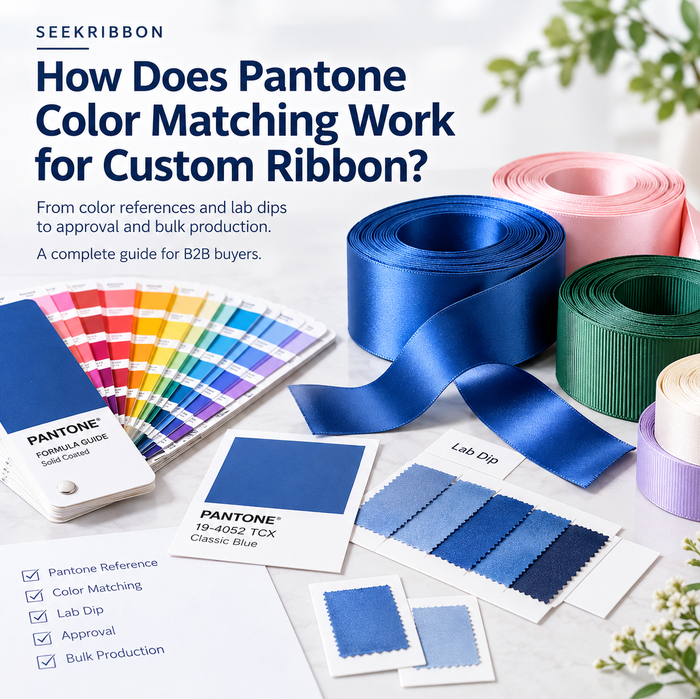
Pantone color matching is the process of using a Pantone reference as a target to develop a specific color on a given material. For custom ribbon, the supplier combines your Pantone reference with the actual ribbon construction—material, width, weave, finish—to create a physical color match.
A Pantone reference should not be treated as a universal dye formula that produces identical results on every material.
A color can look different depending on:
- Ribbon material
- Fiber composition
- Surface texture
- Ribbon construction
- Sheen or finish
- Dyeing process
- Background
- Lighting conditions
For example, the same Pantone blue on smooth, shiny satin ribbon may appear brighter and more saturated than on textured grosgrain or translucent organza.
This is why professional custom ribbon production always involves a physical color-matching process and sample approval before bulk production.
Which Pantone Color System Should You Use for Ribbon?
For ribbon sourcing, the most appropriate reference is usually a textile-oriented Pantone system such as Pantone TCX (Textile Cotton eXtended). Graphic and print projects may use Pantone Solid Coated or Uncoated, but those references are designed for ink on paper, not dye on fabric.
Always specify the exact Pantone system and color number. “Pantone 19-4052” is not enough—state whether it is TCX, TPX, Solid Coated, or another system.
Pantone Reference vs. Physical Color Sample
A Pantone code gives the supplier a defined target. But if your project already has an approved physical color sample, providing that sample is even more valuable.
Useful references to send include:
- Pantone color code (with system)
- Physical Pantone swatch
- Approved ribbon sample
- Fabric sample
- Brand color standard
- Previously approved production sample
If color accuracy is critical, provide both a Pantone reference and a physical sample. The manufacturer can then cross-check the digital reference against the physical standard.
Avoid Relying Only on Screenshots
A common mistake is sending a screenshot from a website or design file and expecting an exact match.
Monitor colors vary because of:
- Screen settings
- Brightness
- Color profiles
- Device differences
- Browser settings
- Ambient lighting
A digital image should never replace an official color reference or physical sample when accurate color matching is required.
How Does Pantone Matching Work for Custom Ribbon?
The process follows six stages: color reference → material confirmation → lab dip development → buyer review → approval → bulk production with color control. Each stage matters. Skipping or rushing any one of them increases the risk of a color mismatch.
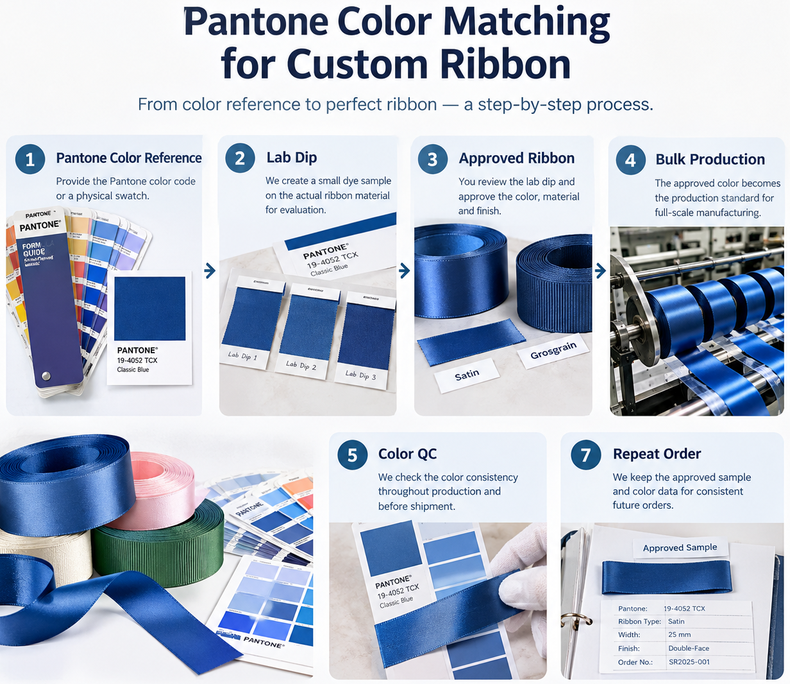
Step 1: Provide Your Color Reference
The buyer provides a complete color specification. The more information you give, the faster and more accurate the matching process.
Ideally, provide:
- Pantone color number and system
- Ribbon type
- Ribbon width
- Intended application
- Estimated order quantity
- Physical color sample, if available
Instead of saying:
“We need a dark blue ribbon.”
Say:
“We need a 1.5-inch double-faced satin ribbon in Pantone 19-4052 TCX, approximately 5,000 yards, for retail packaging.”
The second specification tells the supplier exactly what to develop.
Step 2: Confirm the Ribbon Material
The supplier confirms the actual ribbon construction before color development. Different materials produce different visual results, so the same Pantone target may require different dye formulas.
- Custom satin ribbon has a smooth, reflective surface. Colors appear brighter and more vibrant.
- Custom grosgrain ribbon has a ribbed texture. Light reflects differently, often making colors look slightly deeper or more muted.
- Organza ribbon is lightweight and translucent. The background behind it changes the perceived color.
- Velvet ribbon has a raised pile. Pile direction makes the same color look lighter or darker from different angles.
Never assume a Pantone match on one ribbon type will automatically work on another.
Step 3: Develop a Lab Dip
A lab dip is a small color sample produced before bulk production. It lets both buyer and manufacturer evaluate the proposed color without committing to thousands of yards.
This is the single most important stage in custom ribbon sourcing. It prevents color issues from being discovered after full production.
What Happens Inside the Lab
At SeekRibbon, the lab dip process typically works like this:
- Turnaround time: 5–7 working days after receiving the color reference and ribbon specifications.
- Cost: Usually $50–$150 per lab dip, depending on material and color complexity. This is often credited toward the bulk order.
- Revision rounds: Most projects include 2–3 rounds of color adjustment. Additional rounds may incur a small fee.
- Materials: Lab dips are made using the actual production ribbon material—not a generic fabric—so what you approve is what you get.
- Light sources: We evaluate every lab dip under D65 (daylight), TL84 (store lighting), and tungsten (A) light to simulate real-world viewing conditions.
Step 4: Review the Lab Dip
The buyer reviews the lab dip under consistent lighting and compares it to the original reference. Do not just ask, “Does it look close?”
Check:
- Hue
- Brightness
- Saturation
- Overall appearance
- Ribbon sheen
- Surface texture
- Appearance under different lighting
If possible, compare the lab dip with your Pantone swatch or physical sample under the same light source.
Step 5: Approve the Color
Once approved, the lab dip becomes the production reference. Keep a record of:
- Pantone reference
- Approved physical sample
- Ribbon material
- Ribbon width
- Finish
- Production specifications
- Order number
This record is essential for repeat orders.
Step 6: Control Color During Bulk Production
Color control does not stop after lab dip approval. During bulk production, the manufacturer monitors the ribbon against the approved reference and conducts quality checks before shipment.
For long-term B2B supply, the objective is not to match a color once. The objective is to establish a repeatable color standard for all future production.
Why Can the Same Pantone Color Look Different on Different Ribbons?
A Pantone reference is a target, not a guarantee. The same code can appear visually different across materials because surface texture, sheen, translucency, and pile direction change how light reflects.
Satin Ribbon
Satin’s smooth, reflective surface makes colors appear brighter, deeper, or more vibrant depending on viewing angle and lighting.
Grosgrain Ribbon
Grosgrain’s ribbed texture affects light reflection and therefore color perception. Colors often look slightly more muted than on satin.
Organza Ribbon
Organza is translucent. The background behind the ribbon influences how the color appears. A color that looks correct against a white background may look different over a dark package.
Velvet Ribbon
Velvet’s raised pile reflects light differently depending on direction. The same ribbon can appear lighter or darker from different angles.
Always specify the actual ribbon material and construction when requesting Pantone color matching.
Color Tolerance: What B2B Buyers Should Know
Color tolerance is the acceptable range of variation between the approved standard and production batches. No dyeing process is 100% identical every time. The question is: how much variation is acceptable for your project?
In custom ribbon production, ΔE (Delta E) is the standard measurement of color difference:
| ΔE Range | Match Quality | Typical Application |
|---|---|---|
| ΔE ≤ 1.5 | Excellent match. Visually indistinguishable to most people. | Premium brand packaging, luxury retail |
| ΔE 1.5–2.5 | Good match. Slight difference detectable by trained eye under controlled lighting. | Apparel, brand packaging |
| ΔE 2.5–4 | Acceptable for many commercial applications. | Promotional products, internal use |
| ΔE > 4 | Usually requires adjustment. | Not recommended for brand-sensitive projects |
For brand packaging, apparel, and retail displays, we recommend targeting ΔE ≤ 2.0 against the approved lab dip. For promotional products or internal use, a slightly wider tolerance may be acceptable.
Discuss tolerance requirements with your supplier before production. If you do not specify, you may receive batches that fall within a “standard” range but still look different to you.
Can Pantone Matching Guarantee a 100% Exact Color?
No. Professional color matching aims for controlled, repeatable consistency—not mathematical perfection. Several factors influence the final appearance:
- Material differences
- Dyeing conditions
- Surface characteristics
- Lighting
- Viewing angle
- Production batch
- Color tolerance requirements
For high-volume or brand-sensitive projects, the approved physical sample should be treated as the production reference. The goal is controlled, repeatable color consistency, not reproducing a digital color on a screen.
Pantone Matching vs. Stock Ribbon Colors
Not every project needs a custom Pantone color. Stock colors can be faster and more economical.
| Option | Best For | Main Advantage |
|---|---|---|
| Stock ribbon color | Standard products and repeat purchases | Faster sourcing |
| Pantone custom color | Brand-specific requirements | Custom brand color |
| Physical sample matching | Projects without a suitable Pantone reference | Matches an existing product reference |
If a common red ribbon and an available stock color meet your requirement, custom development may not be necessary. But if your brand requires ribbon to coordinate closely with corporate identity or packaging, custom Pantone matching is more appropriate.
What Should Buyers Ask a Ribbon Supplier About Pantone Matching?
Ask about color systems, material-specific matching, lab dip process, tolerance standards, and repeat-order color retention. These questions help you establish a clear color specification before placing a large order.
Pantone Matching Procurement Checklist
Color Reference
- Can you match Pantone colors for custom ribbon?
- Which Pantone systems do you work with?
- Can I provide a physical color sample?
- Can you match an existing ribbon or fabric sample?
Ribbon Specification
- What ribbon material will be used?
- What fiber composition is available?
- What ribbon width is required?
- Is the ribbon single-faced or double-faced?
- Does the ribbon have a special finish?
Sampling
- Can you provide a lab dip before bulk production?
- Is the lab dip made using the actual ribbon material?
- How many color revisions are included?
- What is the lab dip cost and turnaround time?
- Can I approve the color before bulk production?
Production
- What ΔE tolerance do you guarantee?
- How will the approved color be used during bulk production?
- How is color consistency checked?
- Under which light sources do you evaluate color?
- Can the approved color be retained for future orders?
- How are repeat orders matched to the previous production?
Documentation
- Will the Pantone reference be recorded on the order?
- Can the approved sample be retained as a reference?
- Can production specifications be documented for repeat orders?
Pantone Matching for Different Custom Ribbon Applications
Pantone color matching is useful across many B2B ribbon applications. The same basic principle applies: define the color → match the actual ribbon material → approve the sample → control bulk production.
Brand Packaging
Packaging companies and brands need ribbon colors that coordinate with corporate identity, product packaging, or seasonal campaigns.
Apparel and Fashion
Fashion brands use custom ribbon colors to coordinate with garments, accessories, gift packaging, or seasonal collections.
Hair Bows
Hair bow manufacturers require specific colors to match school colors, team colors, fashion collections, or retail packaging. See our custom ribbon for hair bows solutions.
Medals and Awards
Custom medal ribbons may require specific colors for schools, sporting events, organizations, or corporate programs. Learn more about custom ribbon for medals.
Promotional and Corporate Products
Companies use custom-color ribbon for branded gifts, promotional products, event materials, and presentation packaging. Explore our personalized ribbon solutions.
In each case, the principle is the same: define the color, match the material, approve the sample, control production.
How to Improve Color Consistency on Repeat Ribbon Orders
Repeat orders require a documented color standard—not just a verbal instruction like “make the same ribbon as last time.” Keep a record that includes:
- Pantone color reference
- Approved physical sample
- Ribbon material
- Ribbon width
- Ribbon construction
- Finish
- Printing requirements, if applicable
- Previous order information
- ΔE tolerance used
- Light source used for approval
This creates a clear reference for both buyer and supplier. It also reduces misunderstandings when different purchasing staff members place orders in the future.
What Information Should You Include in a Custom Ribbon RFQ?
A complete RFQ reduces quotation time and prevents production errors. Include:
- Ribbon type: Satin, grosgrain, organza, velvet, cotton, acetate, or another material
- Width: For example, 25 mm, 38 mm, 50 mm, or custom
- Color: Pantone reference (with system) or physical sample
- Quantity: Estimated yards or meters
- Printing: Logo, text, pattern, or no printing
- Packaging: Standard rolls or custom packaging
- Application: Packaging, apparel, hair bows, medals, retail, promotional products, etc.
- Delivery requirement: Target delivery date or project deadline
- Color tolerance: If you have a specific ΔE requirement
The more information the supplier receives at the beginning, the easier it is to determine the appropriate production process.
Frequently Asked Questions
Can any Pantone color be matched to ribbon?
Many Pantone colors can be used as references for custom ribbon color development, but the final appearance depends on ribbon material, construction, finish, and production process. Some very bright or neon colors may not be achievable on certain natural fibers. Discuss your specific color and ribbon type with your supplier before production.
Which Pantone system is best for ribbon?
Textile-oriented systems such as Pantone TCX are generally most appropriate for ribbon. Graphic or branding projects may provide Solid Coated references, but these should be converted with care. Always specify the exact Pantone system and color number.
What is a ribbon lab dip?
A lab dip is a small sample produced to evaluate a proposed ribbon color before bulk production. It allows the buyer to review and approve the color before committing to the full production quantity. At SeekRibbon, lab dips typically take 5–7 working days and cost $50–$150.
Can I use a screenshot to specify my ribbon color?
A screenshot is generally not a reliable substitute for an official Pantone reference or physical color sample because screen settings and color profiles change the appearance of the color.
Will the same Pantone color look identical on satin and grosgrain ribbon?
Not necessarily. Different ribbon surfaces, textures, transparency, and levels of sheen affect how the same target color is perceived. In our experience, satin and grosgrain can show a ΔE difference of 2–4 for the same Pantone reference.
What is the acceptable color difference for custom ribbon?
For brand-critical projects, we recommend targeting ΔE ≤ 2.0 against the approved lab dip. For promotional or internal applications, ΔE 2.5–4 may be acceptable. Always discuss tolerance requirements with your supplier before production.
How much does a ribbon lab dip cost?
Lab dip costs typically range from $50 to $150 depending on material and color complexity. This cost is often credited toward the bulk order. Most projects include 2–3 revision rounds.
What if I don’t like the lab dip?
You can request adjustments. Most manufacturers allow 2–3 rounds of color revision within the lab dip fee. Provide specific feedback—for example, “too red,” “too dark,” or “needs more blue”—rather than general comments.
Can the same custom ribbon color be reproduced for repeat orders?
A documented color reference and approved physical sample help improve repeat-order consistency. Ask your supplier about their color-control and sample-retention process before starting a long-term program. SeekRibbon retains approved standards for repeat customers.
Final Thoughts: Treat Color Matching as Part of Your Procurement Specification
For custom ribbon, Pantone color matching is more than selecting a number from a color chart.
A successful process connects the color reference, actual ribbon material, lab dip, buyer approval, bulk production, and quality control.
For B2B buyers, the most important step is to establish a clear color standard before production begins.
If your ribbon is an important part of your brand packaging, product design, or retail presentation, do not rely only on a digital image or a simple color name such as “red,” “navy,” or “pink.”
Provide a specific color reference, confirm the ribbon construction, review a physical sample, and make sure the approved color can be used as a reference for future production.
Need a Custom Ribbon Color Match?
SeekRibbon works with buyers looking for custom ribbon colors, custom widths, printing, and other ribbon specifications. Send us your Pantone reference, physical color sample, ribbon type, width, and estimated quantity. Our team can help determine the appropriate color-matching process and provide a sample for approval before bulk production.
Request a Custom Ribbon Quote