

What Does a White Ribbon Mean? A Quick Answer
A white ribbon can symbolize different things depending on where and why it is used. It may represent awareness, remembrance, peace, purity, abstinence from alcohol, support for a cause, or even indicate that a horse is for sale. There is no single universal meaning for a white ribbon. Its meaning changes depending on the context in which it appears.
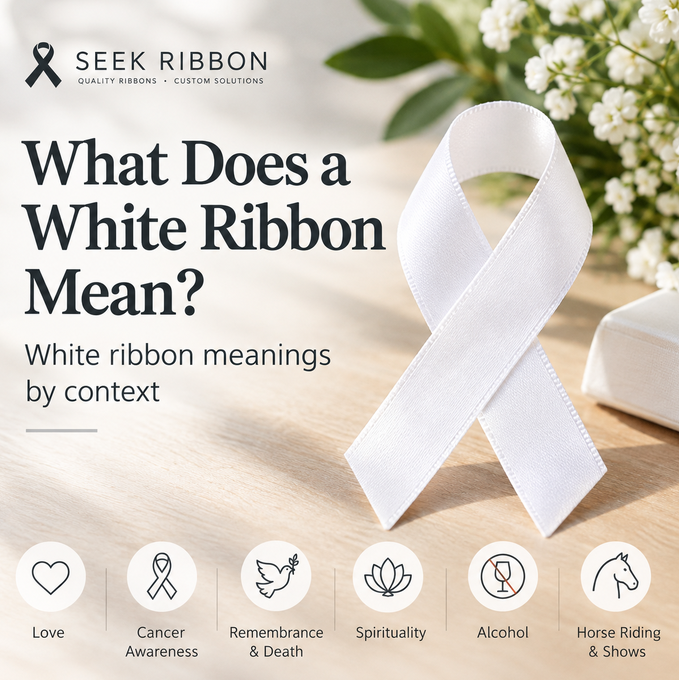
This guide breaks down the most common uses of white ribbons — from lung cancer awareness campaigns to horse shows, funeral traditions to spiritual symbolism — so you can understand exactly what a white ribbon means when you see one.
White Ribbon Meaning at a Glance
The table below provides a general overview. Detailed explanations for each context follow in the sections below.
| Context | Common Meaning |
|---|---|
| Awareness campaigns | Support for a specific cause |
| Violence against women | Commitment to ending violence (ongoing globally in 2026) |
| Lung cancer | Lung cancer awareness |
| Bone cancer | Bone cancer awareness |
| Alcohol / temperance | Abstinence from alcohol |
| Funeral or remembrance | Remembrance, peace, or mourning |
| Spiritual symbolism | Purity, peace, or new beginnings |
| Love / wedding | Purity, devotion, or new beginnings |
| Horse riding | Often indicates a horse is for sale |
| Horse shows | Meaning varies by competition |
| Lapel ribbon | Depends on the campaign or event |
White Ribbon Meaning in Different Contexts
What Does a White Ribbon Mean for Cancer?
White ribbons are most strongly associated with lung cancer awareness in current campaigns. The White Ribbon Project, a grassroots advocacy organization, explicitly uses white ribbons to promote lung cancer awareness, reduce stigma, and build community support for patients and caregivers. The project distributes handmade white ribbons with personal notes to patients, healthcare professionals, and supporters, aiming to make the white ribbon an internationally recognized symbol of hope.

Some sources also associate white ribbons with bone cancer awareness and other health conditions, including postpartum depression, scoliosis, and osteoporosis. Because awareness-ribbon colors are not universally standardized, it is best to identify the organization or campaign behind a particular ribbon rather than assume a single meaning.
What Does a White Ribbon Mean When Someone Dies?
In remembrance and funeral contexts, white ribbons are often used to signify peace, purity, remembrance, and sympathy. They may be worn at memorials or funerals to honor someone who has died as a quiet sign of respect and peace. In some veterans’ remembrance events, a white ribbon specifically commemorates a loved one who gave or lost their life in service. During the COVID-19 pandemic, white ribbons were used in community memorial projects, with each ribbon representing a life lost to the virus.
However, a white ribbon does not have one universal funeral meaning. Different cultures, families, religions, and memorial events may use white ribbons differently. Some may view white as a color of mourning, while others associate it with peace or spiritual transition.
What Does a White Ribbon Mean Spiritually?
In general color symbolism, white is often associated with purity, peace, innocence, hope, and new beginnings. The spiritual meaning of a white ribbon therefore depends on the person’s beliefs and the context in which it is used. For example, in handfasting ceremonies and other spiritual wedding rituals, white ribbons symbolize spiritual purity, truth, serenity, and devotion. In dream interpretation and personal symbolism, a white ribbon may indicate readiness for positive changes or new beginnings.
It is important to note that white ribbons do not carry a single, fixed spiritual doctrine across all traditions. Their meaning is often personal and interpretive rather than universal.
What Does a White Ribbon Mean in Love?
In romantic, wedding, and relationship contexts, white is most often associated with purity, devotion, unity, commitment, and new beginnings. In traditional handfasting ceremonies, a white ribbon laid upon a couple’s clasped hands symbolizes purity, devotion, and peace, and may also represent the fresh start the couple embarks upon together.
In some cultural traditions, a white ribbon tied around both partners’ wrists has been used as a symbol of wedded bliss, sometimes with the ribbon cut to signify a love tragically severed. In German wedding customs, a white ribbon has represented the unity of bride and groom.
However, a white ribbon does not have a universally recognized “love code.” Unlike, say, a red ribbon’s near-universal association with passion, white ribbons in romantic contexts are more about intention and ceremony than a standardized symbolic system.
What Does a White Ribbon Mean for Alcohol?
The white ribbon has a deep historical connection to the temperance movement. In the late 19th and early 20th centuries, the Woman’s Christian Temperance Union (WCTU) adopted a knot of white ribbon as its official badge, first approved at the 1877 convention. The white ribbon symbolized not only purity and peace but also the pledge of total abstinence from alcohol. Members wore the white ribbon as a public commitment to sobriety and to the broader temperance cause.
The white ribbon became such a recognizable symbol of abstinence that “White Ribboner” entered common usage to describe a temperance advocate. In some historical contexts, the phrase “going White Ribbon” referred to taking the temperance pledge.
What Does a White Ribbon Mean on a Horse?
If you see a white ribbon tied to a horse’s tail, it most often means the horse is for sale. In equestrian settings, tail ribbons serve as visual signals to other riders, handlers, and potential buyers. A white ribbon is widely recognized as a way to advertise that a horse is available for purchase at a show or event. This practice allows sellers to discreetly signal availability without disrupting the competition.
However, ribbon colors are not completely standardized across all equestrian disciplines and events. While white-for-sale is one of the most consistent tail ribbon conventions, riders should always check the specific rules or customs of their discipline.
What Does a White Ribbon Mean in Horse Shows?
A white ribbon in a horse show is a different matter entirely from a tail ribbon. In many competition systems, a white ribbon is an award ribbon with a specific placement value. Under the Danish system used in many 4-H and Western horse shows, ribbons are awarded by performance tiers: blue for the highest level, red for the middle tier, and white for the lower tier. A white ribbon in this system indicates a performance that meets basic participation standards but falls below the higher achievement levels.
For example, some 4-H rulebooks define a white ribbon as indicating “average to below average performance not meeting several standards for the class,” while others assign white ribbons to scores in a specific lower range.
The key point is that horse show ribbon meanings depend entirely on the show’s rulebook. Unlike tail ribbons, which follow a more consistent convention, competition award ribbons vary widely across organizations and disciplines.
Why Does White Symbolize Purity and Peace?
The association between white and purity, peace, and innocence is ancient and cross-cultural. In many traditions, white represents cleanliness, spiritual purity, and new beginnings. The WCTU’s 1912 newspaper description captured this well: “The white ribbon is symbolic not only of purity and peace, but it includes all the correlated reforms that center in the protection of the home.”
In Western religious contexts, white is often associated with light, divine presence, and renewal. In secular contexts, white is used in weddings to symbolize purity, in medicine to represent cleanliness, and in peace movements to represent non-violence. The white dove, the white flag, and the white ribbon all draw on this shared symbolic reservoir.
Understanding this broader symbolism helps explain why white ribbons can carry such different meanings across contexts — the underlying color association provides a common thread, while the specific context determines what the ribbon is actually communicating.
The History of the White Ribbon
The white ribbon does not have one origin or one meaning. It has been adopted and re-adopted by different movements over more than a century.
The Temperance Movement (late 1800s)
The earliest widespread use of the white ribbon as a symbol emerged from the temperance movement. The Woman’s Christian Temperance Union adopted the white ribbon badge in 1877, and by the early 20th century the organization had grown to over half a million members across more than 50 nations. The white ribbon became one of the most recognizable symbols of the abstinence movement.
The White Ribbon Campaign (1991)
In 1991, a new white ribbon movement emerged in Canada. Following the 1989 École Polytechnique massacre in Montreal, where 14 women were murdered, three men in Toronto initiated a campaign to engage men in ending violence against women. The white ribbon became a symbol of a man’s pledge to never commit, condone, or remain silent about violence against women. Nearly 100,000 men wore the white ribbon in the campaign’s first year, and by 2006, over 800,000 ribbons had been distributed across 55 countries. The United Nations designated November 25 as the International Day for the Elimination of Violence Against Women, now closely associated with White Ribbon Day.
Awareness Ribbons (late 20th century onward)
From the 1990s onward, white ribbons were adopted by various health and social awareness campaigns, most prominently The White Ribbon Project for lung cancer awareness, founded in 2020. The awareness ribbon format — a looped ribbon worn on a lapel or pinned to clothing — became a standard visual language for health advocacy.
Each of these movements adopted the white ribbon for different reasons, but the shared symbol has created overlapping meanings that require context to interpret correctly.
White Ribbon Campaign Today (2026)
The White Ribbon Campaign remains active worldwide in 2026. White Ribbon UK, White Ribbon Australia, White Ribbon New Zealand, and affiliated organizations across the United States and Europe continue to use the white ribbon as the primary symbol of the movement to end men’s violence against women and girls.
The campaign has not faded with time. In 2026, White Ribbon Day is observed on 25 November, marking the start of the annual 16 Days of Action against gender-based violence. White Ribbon UK has announced the theme for White Ribbon Day 2026: “It Takes All of Us” — a call to recognize that gender inequality, sexism, and misogyny harm everyone, and that everyone must play a part in creating a world where all people are safe, equal, and respected.
White Ribbon UK also continues to recruit Ambassadors — primarily men who commit to the White Ribbon Promise to never use, excuse, or remain silent about men’s violence against women — and Champions, who help promote respect, equality, and a culture free from violence in their communities. In 2026, organizations across the UK — from local councils to Premier League football clubs — renewed their White Ribbon accreditation and publicly recommitted to preventing violence against women and girls.
In the United States, White Ribbon Day events continued in 2026 at institutions such as Lahey Hospital & Medical Center in Burlington, Massachusetts, which held its fifth annual observance in March and concluded with attendees taking the Massachusetts White Ribbon Day Pledge. In Australia, White Ribbon Australia launched school-based prevention programs and appointed new members to its Workplace Accreditation Panel, while students organized White Ribbon walks to open conversations about domestic violence.
The campaign’s core message remains unchanged since 1991: wearing a white ribbon is a personal pledge to never commit, condone, or remain silent about violence against women and girls. In 2026, that pledge continues to be taken by hundreds of thousands of men and boys across more than 60 countries.
White Ribbon vs. White Awareness Ribbon: Are They the Same?
Not exactly. A “white ribbon” is a general term for any white-colored ribbon used for any purpose. A “white awareness ribbon” is a specific format — typically a looped ribbon worn on clothing or displayed at events — designed to raise awareness for a particular cause.
You might encounter a white satin ribbon used as wedding decor or gift wrapping. That is a white ribbon, but it is not an awareness ribbon. Conversely, a white awareness ribbon worn on a lapel is almost always intended to signal support for a specific campaign or cause.
The distinction matters because it affects how you interpret what you see. A white ribbon in a floral arrangement is decorative. A white awareness ribbon pinned to someone’s jacket is communicative.
White Ribbon Meaning: Scene-by-Scene Quick Guide
| You See a White Ribbon… | It May Mean… |
|---|---|
| On a lapel | Support for a specific cause or campaign |
| At a memorial | Remembrance or tribute |
| At a wedding | Decoration, purity, unity, or new beginnings |
| On a horse’s tail | Often “for sale” |
| In a horse competition | Depends on the show’s award system |
| In a cancer campaign | Often linked to lung cancer awareness |
| In a temperance context | Abstinence from alcohol |
| In a spiritual context | Purity, peace, or renewal |
Frequently Asked Questions About White Ribbons
1. What does a white ribbon mean?
A white ribbon does not have one single meaning. Its meaning depends on the context. It may represent awareness, remembrance, peace, purity, abstinence from alcohol, support for a cause, or indicate that a horse is for sale.
2. What does a white ribbon mean when someone dies?
In memorial and funeral contexts, a white ribbon generally signifies remembrance, peace, sympathy, and respect. However, customs vary by culture, religion, and family tradition.
3. What does a white ribbon mean spiritually?
Spiritually, white is often associated with purity, peace, innocence, and new beginnings. The specific meaning of a white ribbon depends on the person’s beliefs and the context in which it is used.
4. What does a white ribbon mean for cancer?
White ribbons are most strongly associated with lung cancer awareness, particularly through The White Ribbon Project. Some sources also associate white ribbons with bone cancer awareness and other health conditions. Because awareness ribbon colors are not standardized globally, it is best to identify the specific organization behind the ribbon.
5. What does a white ribbon mean on a horse?
A white ribbon tied to a horse’s tail most often means the horse is for sale. This is a common equestrian convention that allows sellers to advertise discreetly at shows and events.
6. What does a white ribbon mean in horse shows?
In horse shows, a white ribbon is typically an award ribbon indicating a lower placement tier. The exact meaning depends on the competition’s rules. Under the Danish system, white ribbons are awarded for performances that meet basic standards but fall below higher achievement levels.
7. What does a white ribbon mean for alcohol?
Historically, the white ribbon was a symbol of the temperance movement and represented a pledge of total abstinence from alcohol. The Woman’s Christian Temperance Union adopted the white ribbon as its official badge in 1877.
8. Is the White Ribbon Campaign still active in 2026?
Yes. The White Ribbon Campaign continues to operate globally in 2026. White Ribbon Day is observed on 25 November each year, and organizations in the UK, Australia, New Zealand, the United States, and other countries continue to use the white ribbon as a symbol of the pledge to end men’s violence against women and girls.
9. What does a white lapel ribbon mean?
The meaning of a white lapel ribbon depends entirely on the campaign or event. It could signal support for lung cancer awareness, ending violence against women, or another cause. Without context, it is impossible to assign a single meaning.
10. Does a white ribbon always mean peace?
No. While white is often associated with peace, a white ribbon’s meaning depends on context. It could represent awareness, remembrance, abstinence, or a horse for sale — among other meanings.
11. Is there one universal meaning for a white ribbon?
No. There is no single universal meaning for a white ribbon. Its meaning changes depending on the context, the organization using it, and the cultural setting in which it appears.
Choosing the Right White Ribbon for Your Project
If you are planning to use white ribbons for a specific purpose — an awareness campaign, a memorial event, a wedding, a horse show, packaging, or custom branding — the right choice depends on the application.
Common ribbon materials include:
- Satin ribbon — smooth, glossy finish; popular for weddings, gift wrapping, and decorative applications
- Grosgrain ribbon — textured, ribbed surface; durable and commonly used for awareness ribbons and promotional items
- Organza ribbon — sheer, lightweight; often used for elegant event decor and floral arrangements
- Velvet ribbon — soft, luxurious; suited for high-end packaging and ceremonial use
- Custom printed ribbon — allows organizations to add logos, campaign messages, or event details
The right white ribbon depends on the application, width, finish, and whether you need stock or custom production.
For wholesale and custom ribbon solutions — including specific widths, materials, colors, and custom printing — contact Seek Ribbon to discuss your project requirements.