

A ribbon is one of the smallest components on a garment. Yet the wrong width, texture, or fiber content can change how a collar falls, how a waist tie drapes, or whether a trim survives the first commercial wash. This is not a minor detail in garment development — it is a sourcing decision that affects fit, finish, and customer satisfaction.
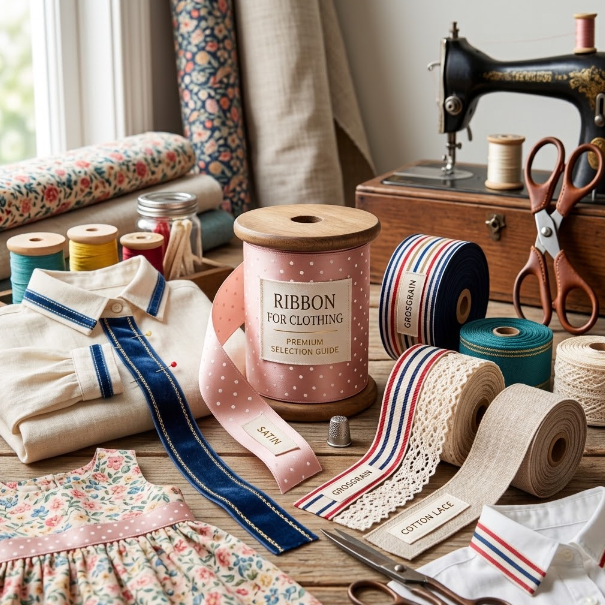
This guide is written for apparel brands, garment manufacturers, fashion designers, and trim sourcing teams who need to match ribbon type to actual garment requirements — not just pick a color from a catalog. It covers the main ribbon constructions used in clothing, explains how to choose by garment type and position, and outlines the information suppliers need before quoting a production order.
Why Ribbon Choice Matters in Clothing
Ribbon is often treated as an accessory decision made late in development, after the fabric, silhouette, and construction are already locked. That sequencing is backwards. A grosgrain ribbon chosen for a waist stay affects how a dress sits on the body. An organza trim chosen for a sheer blouse affects how light passes through the finished garment. A satin ribbon chosen for a bow affects how the bow holds its shape after a day of wear and a trip through the wash.
Ribbon choices also affect production. A ribbon that frays at cut edges slows down sewing and increases reject rates. A ribbon that shrinks differently from the garment fabric can cause puckering along a hem. A ribbon with poor colorfastness can bleed onto light-colored fabric during finishing or after the first customer wash.
The goal of this guide is to help you choose ribbon based on where it sits on the garment, what the surrounding fabric can support, and what the finished piece needs to do — rather than on appearance alone.
What Is Ribbon Used for in Clothing?
Ribbon in apparel falls into two broad categories: decorative and functional. The distinction matters because the same ribbon that works beautifully as a decorative bow may fail entirely as a structural waist stay.
Decorative applications include bows and waist ties on dresses and blouses, visible trim along collars, cuffs, and hems, contrast accents on casualwear, and surface embellishment on eveningwear. These applications prioritize appearance, drape, and how the ribbon interacts visually with the garment fabric.
Functional applications include twill tape used to stabilize shoulder seams, grosgrain ribbon as an internal waist stay in strapless or heavy dresses, ribbon used to create button loops or hanging loops, and reinforcement at stress points such as pocket openings or side vents.
Some ribbons can serve both roles depending on construction and placement. A grosgrain ribbon, for example, works as a decorative waist trim on a structured dress and also functions as a supportive waist stay underneath. But a lightweight satin ribbon used as seam reinforcement will likely distort or fail. Treating all ribbons as interchangeable is one of the most common — and most costly — sourcing mistakes in garment development.
Which Type of Ribbon Is Best for Clothing?
There is no single best ribbon for clothing. The right choice depends on where the ribbon sits on the garment, what the surrounding fabric can support, and what the finished piece needs to do. Below is a practical comparison of the main ribbon types used in apparel production.
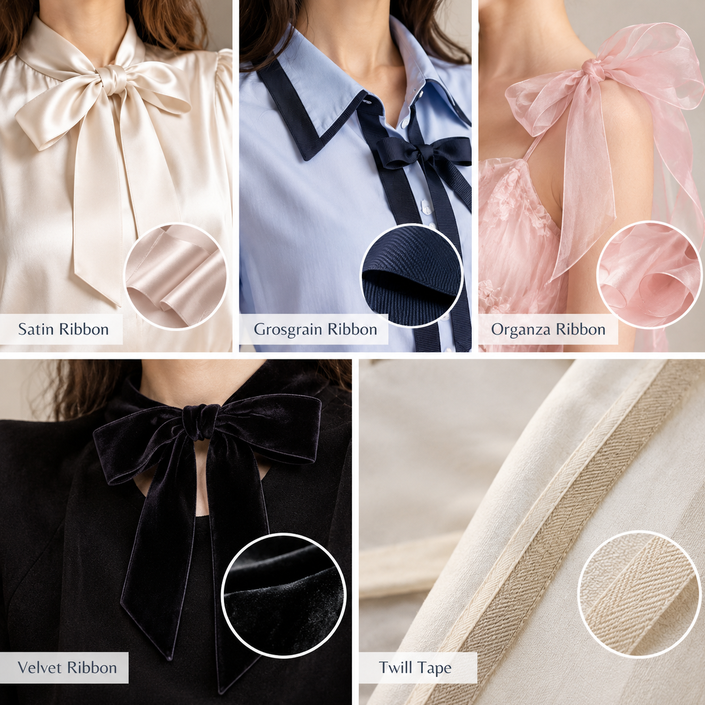
Satin Ribbon
Satin ribbon has a smooth, lustrous face created by a satin weave in which warp yarns float over weft yarns. It is typically made from polyester, acetate, or nylon, with polyester satin dominating commercial production due to its durability and cost efficiency.
In clothing, satin ribbon is most effective for decorative details: bows at the waist or back of a dress, trim on eveningwear, and soft accents on blouses. A critical sourcing point: satin ribbon’s smooth surface is more vulnerable to abrasion and fraying than a tightly woven ribbed ribbon, so cut edges need finishing on any garment that will be worn or washed. For tied bows where both sides show, specify double-faced satin. For sewn-on trim where only the face is visible, single-faced satin is more economical.
Grosgrain Ribbon
Grosgrain ribbon is woven with a high density of warp threads against thicker weft yarns, producing a distinct horizontal ribbed texture that is consistent on both faces. It is firmer and more structured than satin, holds its shape well, and is more resistant to fraying at cut edges.
In garment construction, grosgrain is the preferred choice for waist stays, internal support in strapless or heavy dresses, and decorative trim on structured garments such as tailored jackets or formal trousers. Its matte, ribbed surface reads as professional and understated, making it suitable for uniforms and branded apparel where a glossy finish would be inappropriate. The trade-off is that grosgrain has less drape than satin — on a lightweight, flowing fabric, it can look stiff or out of proportion.
Organza Ribbon
Organza ribbon is sheer, lightweight, and has a subtle shimmer. It is commonly made from nylon or polyester. In clothing, organza ribbon is best suited to garments where transparency is intentional: layered trim on tulle skirts, delicate accents on bridal wear, or light decorative details on sheer blouses. The main sourcing consideration is edge finish — organza edges can be heat-sealed or stitched, and the choice affects both appearance and durability.
Velvet Ribbon
Velvet ribbon has a cut-pile surface that gives it a soft, plush hand and a rich visual depth. It is typically used in fall and winter collections, on coats, jackets, and premium dresses where texture is part of the design language. A key production detail: velvet has a pile direction, and the ribbon should be sewn with the nap running upward to maximize luster. Sewing with the pile running down makes the ribbon appear dull. This is a genuine manufacturing consideration that affects cutting layout and operator instruction.
Twill Tape
Twill tape is a flat, tightly woven tape — often made from cotton or cotton-blend — used primarily for functional reinforcement rather than decoration. It stabilizes seams, reinforces buttons, binds raw fabric edges, and creates casings for elastic or cording. Twill tape is not typically chosen for its appearance. It is chosen because it adds strength without adding bulk, and because its tight weave resists stretching and distortion under stress. For garment reinforcement, specify the tape’s width, fiber content, and whether it needs to withstand garment washing or dry cleaning.
Custom Printed Ribbon
Custom printed ribbon carries brand text, logos, or patterns. In clothing, it serves two distinct functions: as a visible brand detail sewn onto the garment (for example, a logo ribbon along an interior placket), and as packaging material for the finished product. These are different sourcing requirements — garment-sewn ribbon must meet the same care and durability standards as other trims, while packaging ribbon prioritizes print clarity and appearance. Do not assume one specification covers both.
How to Choose Ribbon for Different Garments
The table below gives a starting point for matching ribbon type to garment use. It is a directional guide, not a fixed rule — final selection depends on the specific fabric, ribbon construction, and performance requirements of each style.
| Clothing Application | Ribbon to Consider | What to Check |
|---|---|---|
| Dress bows and waist details | Satin ribbon | Drape, sheen, width proportion to garment scale |
| Blouse and shirt decoration | Satin or grosgrain | Weight relative to fabric; sewing compatibility |
| Sheer or lightweight garments | Organza ribbon | Transparency level; edge finish method |
| Structured decorative trims | Grosgrain ribbon | Texture, stiffness, fray resistance |
| Premium fashion accents | Velvet ribbon | Pile direction, thickness, seam bulk |
| Seams and garment finishing | Suitable twill tape | Tensile strength, construction, wash performance |
| Branded clothing accessories | Custom printed ribbon | Print clarity, color accuracy, dimensions |
Dresses and Eveningwear
Satin and organza are the most common choices for dresses and eveningwear. The critical test is drape — a ribbon that feels right on the roll may stiffen or sag once attached to the garment. Order sample lengths and sew them onto the actual garment fabric before committing to a production run.
Blouses and Shirts
Ribbon is often used at the collar, cuffs, or as a front placket accent on blouses and shirts. Here, the ribbon’s weight must be balanced against the fabric’s weight. A heavy grosgrain on a lightweight cotton poplin will pull and distort the shirt front. A finer satin or a lightweight grosgrain in a narrower width is usually more compatible.
Children’s Clothing
Safety and comfort take priority in children’s clothing. Ribbons used near the neck or as ties should be soft, free of sharp edges, and securely attached. Avoid long trailing ribbons that could pose a strangulation risk. For washability, specify colorfast ribbon that can withstand frequent laundering without bleeding or fading.
Lingerie and Sleepwear
Narrow satin or stretch ribbons are common for straps and decorative trim in lingerie and sleepwear. The ribbon must be soft against skin and retain its shape after washing. Stretch ribbon with a central groove is particularly suitable for piping and lingerie applications.
Casualwear and Fashion Trims
Grosgrain and twill tape are frequently used for visible topstitching, pocket trim, and waistband accents on casualwear. These applications benefit from grosgrain’s durability and shape retention.
Uniforms and Branded Apparel
Custom printed grosgrain or twill tape can carry brand text while meeting the durability requirements of workwear. Specify wash fastness standards based on the garment’s care label — industrial laundering requirements differ significantly from home washing.
How to Choose the Right Ribbon Width, Material and Color
Width is one of the most consequential and most overlooked specifications. A 3 mm ribbon works for delicate accents and fine garment details; 7 mm suits small bows and trim on lightweight garments; 15 mm is the most versatile all-purpose width for clothing; and 25 mm or wider is appropriate when the ribbon itself is meant to be a major design feature, such as a statement waist tie or a large bow.
A practical approach: match the ribbon width to the scale of the garment detail, not to the garment as a whole. A narrow ribbon on a large bow looks mean; a wide ribbon on a small collar detail overwhelms the proportion.
Fiber content determines how the ribbon behaves during sewing, wearing, and washing. Polyester ribbon is durable, colorfast, and cost-effective for most commercial applications. Cotton ribbon has a softer, more natural hand but may shrink or wrinkle unless pre-shrunk. Nylon offers strength and a degree of elasticity. For garments requiring specific care — machine wash, tumble dry, dry clean — confirm the ribbon’s wash performance and shrinkage rate before production.
Color matching is another area where screens mislead. A color that looks correct on a monitor may differ from the actual garment fabric under natural light, under retail lighting, and after washing. Always confirm color with a physical swatch against the actual garment fabric. For custom-dyed ribbon, request a lab dip or production sample and evaluate it in the lighting conditions where the finished garment will be sold and worn.
Pre-Production Ribbon Checklist
- Purpose: decorative or functional (or both)?
- Ribbon type: satin, grosgrain, organza, velvet, twill tape, or custom printed?
- Width: in millimeters, matched to garment scale
- Fiber content: polyester, cotton, nylon, or blend?
- Color: confirmed against physical fabric swatch, not screen
- Softness and drape: tested on actual garment fabric
- Sewing method: machine sewn, hand sewn, or bonded? Edge finish required?
- Washability: tested to the garment’s care label standard
- Colorfastness: tested for bleeding, fading, and staining adjacent fabric
- Sample approval: physical sample sewn onto garment before bulk order
Custom Ribbon for Clothing Brands
For brands developing custom ribbon — whether for sewn-in garment trim or for packaging — the specification process is more detailed than ordering a stock color. Custom orders typically involve confirmation of width, fiber content, color (via Pantone reference or physical swatch), print or logo artwork, and packaging format.
Print method affects both appearance and durability. Options include ink printing, foil stamping, heat transfer, and woven logo construction. For garment-sewn ribbon, the print must survive the garment’s wash and care process. For packaging ribbon, appearance and print clarity take priority.
The sample confirmation stage is where most custom ribbon projects either succeed or fail. A printed logo that looks crisp on a digital proof may bleed, misregister, or fade on the actual ribbon substrate. Request a physical pre-production sample — printed on the specified ribbon, in the specified width and color — and evaluate it on the actual garment or packaging before approving bulk production.
For brands sourcing custom ribbon for clothing applications, Seek Ribbon offers personalized ribbon in a range of substrates, widths, and print methods, with sample confirmation before bulk production. For satin, grosgrain, organza, and velvet options, see the full ribbon product range.
What to Confirm Before Ordering Ribbon for Clothing
Before requesting a quotation from a ribbon supplier, prepare the following information. Suppliers who receive complete specifications can quote faster and more accurately, and brands avoid the cost of re-sampling or, worse, receiving bulk ribbon that does not perform as expected.
- Application: where on the garment will the ribbon be used?
- Ribbon type and construction: satin, grosgrain, organza, velvet, twill tape, or custom printed?
- Material / fiber content: polyester, cotton, nylon, or blend?
- Width: specified in millimeters
- Color: Pantone reference or physical swatch
- Roll length: standard roll length or custom
- Order quantity: total meters or yards, with allowance for waste
- Testing standards: wash fastness, colorfastness, shrinkage limits
- Packaging format: roll, spool, or cut lengths?
- Delivery timeline: required date for sample and bulk production
Need help matching ribbon to a specific garment or preparing a quotation request? Our team can recommend the right construction and provide samples for testing.
Contact Seek RibbonFAQs About Ribbon for Clothing
What type of ribbon is best for clothing?
There is no single best type. Satin ribbon suits decorative bows and eveningwear details. Grosgrain ribbon is better for structured trims and waist stays. Organza works for sheer, lightweight garments. Velvet adds texture to premium designs. Twill tape handles functional reinforcement. The right choice depends on where the ribbon is used and what it needs to do.
Can satin ribbon be sewn onto clothing?
Yes. Satin ribbon is commonly sewn onto garments for decorative trim. However, its smooth surface frays more easily than grosgrain, so cut edges should be finished. Test stitch density and feed settings on the actual garment fabric before production — satin can slip under the presser foot, especially on lightweight fabrics.
What is the difference between satin and grosgrain ribbon for garments?
Satin ribbon has a smooth, glossy surface and drapes softly. Grosgrain ribbon has a ribbed, matte texture and holds its shape firmly. Satin is primarily decorative; grosgrain is suitable for both decorative and functional applications such as waist stays. Grosgrain also resists fraying better and is reversible.
How do you choose ribbon width for clothing?
Match the ribbon width to the scale of the garment detail. Narrow ribbons (3–7 mm) suit fine accents and small bows. A 15 mm width is the most versatile for general clothing use. Wider ribbons (25 mm and above) work when the ribbon itself is a design feature, such as a large bow or a statement waist tie. Always test the ribbon sewn onto the actual garment fabric before deciding.
What should clothing brands consider when ordering custom ribbon?
Confirm the application first — garment-sewn ribbon and packaging ribbon have different performance requirements. Specify width, fiber content, color reference, and print method. Request a physical pre-production sample and test it for wash fastness, colorfastness, and print durability according to the garment’s care label. Do not approve bulk production based on a digital proof alone.