
Ribbon patterns can look deceptively similar. A ribbon with small, even squares may be called gingham, while another with intersecting colored stripes may be described as plaid. Checkered, gingham, and plaid are related — but they are not interchangeable terms.
This confusion is not limited to casual shoppers. In procurement and product development, using the wrong terminology can lead to production errors, mismatched samples, and wasted time on both sides of a supply chain. A buyer who asks for “plaid ribbon” without further specification may receive something entirely different from what they envisioned.
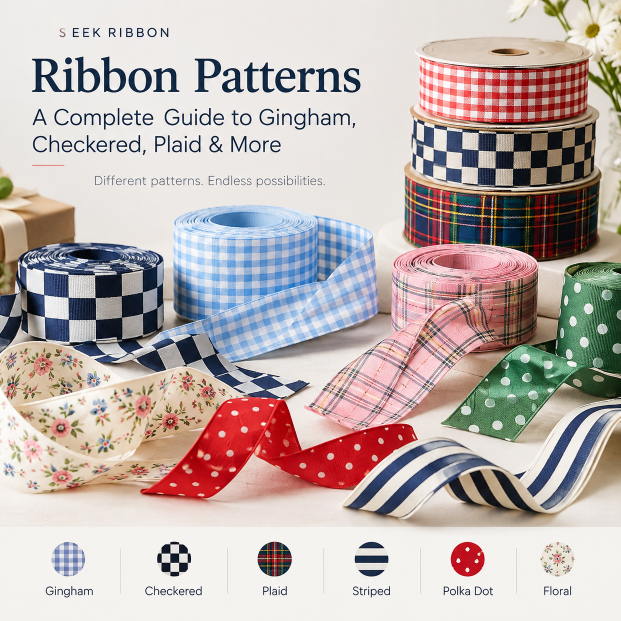
In this guide, we’ll explain how common ribbon patterns are structured, how to tell gingham from checkered and plaid, and how pattern choice affects the look and application of a ribbon. Whether you are sourcing custom ribbon for packaging, selecting trims for apparel, or specifying a pattern for a branded program, this guide will give you the vocabulary and frameworks to communicate precisely.
What Is a Ribbon Pattern?
What Does “Ribbon Pattern” Mean?
A ribbon pattern refers to the visual arrangement of color, lines, shapes, or repeated motifs on the surface of a ribbon. This can include:
- Color blocks and arrangements
- Lines (horizontal, vertical, diagonal)
- Geometric shapes and grids
- Repeated motifs such as dots, florals, or seasonal icons
- Woven-in designs created through yarn structure
The key distinction to understand is that a ribbon pattern is separate from the ribbon material or construction.
Pattern vs. Material
A common source of confusion in ribbon sourcing is conflating pattern with material. These are different attributes:
| Attribute | What It Describes | Examples |
|---|---|---|
| Material / Construction | How the ribbon is made | Satin, grosgrain, organza, velvet, cotton |
| Pattern | What the ribbon looks like | Gingham, plaid, stripes, polka dot, floral |
A satin ribbon can have a gingham pattern. A grosgrain ribbon can have a plaid pattern. An organza ribbon can have a printed floral pattern. These attributes combine independently.
This distinction matters practically. When you specify a ribbon for production, you must define both the material and the pattern. Saying “I need gingham ribbon” is incomplete. Saying “I need a 25 mm polyester grosgrain ribbon with a small-scale gingham pattern” gives a manufacturer everything they need to quote and produce accurately.
The Main Types of Ribbon Patterns
Before comparing gingham, checkered, and plaid in detail, it helps to see where they sit within the broader landscape of ribbon patterns.
Checkered Patterns
A checkered pattern consists of squares in two or more alternating colors positioned in a grid. The simplest version is a black-and-white checkerboard, but variations can use any color combination. Checkered patterns are characterized by:
- Alternating squares in a regular grid
- Typically two colors
- Bold, geometric appearance
- High visual contrast
Checkered prints are often used for children’s ribbons, casual packaging, and craft applications where a playful, graphic look is desired.
Gingham Patterns
Gingham is a specific type of check pattern with a well-defined structure. A plain weave, lightweight cotton fabric with a check pattern, gingham was originally imported in the 17th century to Europe from Southeast Asia as a striped fabric. By the mid-18th century, the mills of Manchester were selling gingham with a blue and white checked pattern.
Gingham is typically made with two colors of yarn in both the warp and filling directions. The color changes are made at evenly spaced intervals to produce a balanced pattern of square blocks. Traditional gingham commonly uses one main color with white or a lighter ground, creating a highly regular checked effect.
Plaid Patterns
Plaid is a pattern formed from criss-crossing lines of varying widths in one, two, or three colors. It is more complex than gingham or simple checkered patterns because the stripes can vary in width, spacing, and color sequence.
The Getty Research Institute defines plaid as “the characteristic pattern known from plaid textiles, consisting of bars or stripes of various colors crossing each other at right angles over a contrasting background color.” Plaid patterns are generally more intricate than checks, featuring asymmetrical or irregular patterns.
Tartan Patterns
Tartan is closely related to plaid but carries specific cultural and historical associations. In North America, the terms tartan and plaid are often used interchangeably, but they have separate meanings. Essentially, all tartans are plaids, but what makes plaid a tartan is its association with a particular social group or topographical area.
Tartans have an identical pattern of stripes running vertically and horizontally, resulting in overlapping square grids. Regular plaids are not necessarily the same in both directions, with variation in color, size, and pattern of stripes. In addition, tartan is almost always woven in a two-over-two twill pattern, which forms the illusion of new colors blended from the original ones.
In Scotland, the word “plaid” comes from the Gaelic word for blanket, and it is used to describe the large kind of kilt worn over the shoulder, not the fabric pattern itself.
Striped Ribbon Patterns
Striped ribbons include horizontal stripes, vertical stripes, diagonal stripes, and multi-stripe arrangements. Stripes are one of the most versatile ribbon patterns because they can be produced in any color combination and at any scale.
Polka Dot Ribbon
Polka dot patterns feature regularly spaced circular dots. Like stripes, polka dots are highly customizable in terms of dot size, spacing, and color.
Floral Ribbon Patterns
Floral patterns range from simple repeated small motifs to complex, multi-color botanical designs. Floral ribbons are commonly used for gift wrapping, floral arrangements, and seasonal packaging.
Geometric Ribbon Patterns
Beyond checks and stripes, geometric patterns include triangles, diamonds, chevrons, and abstract shapes. These patterns are often used for modern packaging and contemporary brand identities.
Seasonal and Holiday Patterns
Seasonal patterns include Christmas motifs (snowflakes, trees, holly), Halloween designs, Valentine’s Day hearts, and Easter themes. These patterns are typically used for limited-run packaging and promotional applications.
Gingham vs. Checkered vs. Plaid: What’s the Difference?
Quick Answer
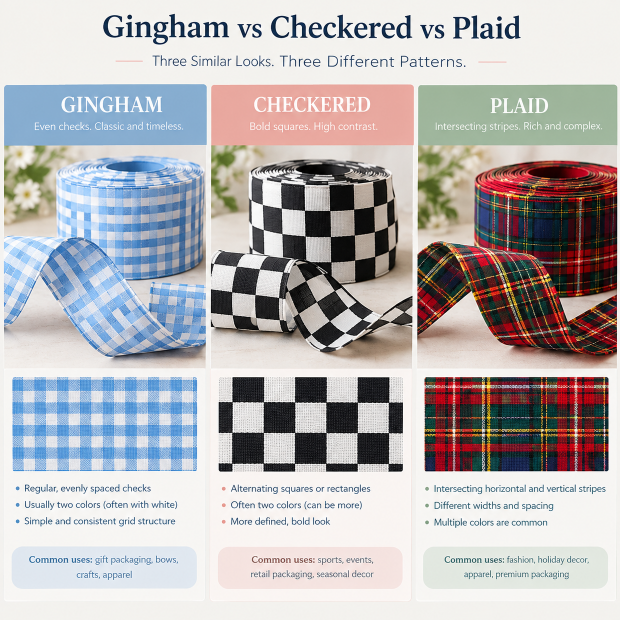
| Pattern | What to Look For | Typical Structure |
|---|---|---|
| Gingham | Even, balanced checks | Regular bands and uniform squares |
| Checkered | Alternating squares | Simple repeated checkerboard effect |
| Plaid | Intersecting stripes | Different widths, spacing, and colors |
Gingham in Detail
Gingham is a specific type of check pattern. Its defining characteristics are:
- Evenly spaced bands: The color bands in both warp and weft directions are equal in width.
- Consistent grid: The result is a perfectly regular square grid.
- Simple color structure: Traditional gingham commonly uses one main color with white or a lighter ground.
- Balanced appearance: The pattern is symmetrical in both directions.
The critical point is that gingham is not synonymous with all checkered patterns. Gingham is a specific type of check pattern — one with a very particular structure of evenly spaced, uniform bands.
Checkered in Detail
Checkered is a broader visual concept than gingham. A checkered pattern consists of squares in two different colors positioned in alternating positions, similar to a checkerboard or a racing flag.
Key characteristics of checkered patterns include:
- Horizontal and vertical lines forming a grid
- Repeated squares or rectangles in a regular geometric structure
- Simple two-color alternation in its most basic form
- High contrast between the alternating squares
Checkered patterns can be more varied than gingham. The squares may be equal in size, or they may vary. The lines may be uniform or varied. This makes “checkered” a broader category that includes gingham as one specific type.
Plaid in Detail
Plaid is the most complex of the three patterns. Its identification does not depend on whether the design forms squares, but rather on the structure of the intersecting bands:
- Intersecting horizontal and vertical bands at right angles
- Different stripe widths: The bands are not necessarily uniform in width
- Different spacing: The intervals between stripes can vary
- Multiple colors: Plaid commonly uses two, three, or more colors
- More complex visual structure: The overall effect is richer and more layered than a simple check
The characteristic bars or stripes may be evenly spaced and repeated, or unevenly spaced and randomly repeated. This variability is what distinguishes plaid from the strict regularity of gingham.
How to Tell Gingham, Checkered, and Plaid Apart
This section provides a step-by-step visual identification method.
Step 1 — Look at the Squares
Ask yourself: Are the squares highly uniform?
If the answer is yes, you are in gingham or checkered territory. If the squares vary in size or the grid is irregular, you are more likely looking at a plaid.
Step 2 — Look at the Stripes
Ask: Are the horizontal and vertical bands the same width?
If the bands are very consistent and equal in width, gingham is the more likely classification. If the widths change noticeably — some bands wide, some narrow — plaid is more likely.
Step 3 — Look at the Color Arrangement
Ask: Is the design based on a simple two-color repeat?
If yes, gingham or checkered is more likely. If the design contains multiple overlapping stripe colors, plaid is the better classification.
Step 4 — Look at the Overall Complexity
A practical visual logic flows from simple to complex:
Checkered → Gingham → Plaid → Tartan
This is a practical visual guide, not a strict textile taxonomy. In reality, terminology overlaps, and different markets and retailers use these terms inconsistently. However, this progression provides a useful mental model for most ribbon applications.
A Simple Way to Identify a Ribbon Pattern
The following decision tree can help you quickly classify a ribbon pattern:
- Does the design use repeated squares? No → It may be stripes, polka dots, floral, or another pattern. Yes → Continue to step 2.
- Are the squares created by evenly spaced, consistent bands? Yes → Gingham.
- Is it a simple alternating checkerboard? Yes → Checkered.
- Are there crossing stripes with different widths, spacing, or colors? Yes → Plaid.
- Does it follow a specific traditional tartan structure? Yes → Tartan. No → Plaid (generic).
Why Ribbon Pattern Matters When Choosing Ribbon
Brand Style
Pattern choice communicates brand identity before a customer reads a single word.
- Gingham is often associated with casual, playful, and nostalgic qualities. It evokes summer, picnics, and traditional Americana.
- Plaid is often associated with heritage, seasonal warmth, and fashion. It can signal tradition, quality, and craftsmanship.
- Geometric patterns are often associated with modern, structured, and precise brand identities.
- Floral patterns are often associated with romantic, decorative, and feminine aesthetics.
These associations are not absolute, but they provide useful starting points for brand-aligned ribbon selection.
Packaging
Ribbon pattern choice affects how packaging is perceived:
- Gift packaging: Gingham and small-scale checks convey thoughtfulness and charm.
- Luxury packaging: Fine plaid or subtle geometric patterns can signal premium quality.
- Bakery packaging: Gingham is a classic choice that suggests freshness and homemade quality.
- Seasonal packaging: Plaid and tartan patterns are strongly associated with winter holidays.
- Retail packaging: Geometric and striped patterns work well for contemporary retail brands.
- Boutique packaging: Floral and unique patterns can differentiate a boutique’s unboxing experience.
Fashion & Apparel
Ribbon patterns are used in apparel for:
- Hair bows and hair accessories
- Garment trims and accents
- Uniform embellishments
- Accessories and bag details
Pattern scale is particularly important in apparel, where small-scale gingham reads as delicate while large-scale plaid makes a bold statement.
Craft & DIY
In craft applications, ribbon patterns are used for:
- Bow making
- Wreath decoration
- Scrapbooking and paper crafts
- Sewing projects
- Party decorations
How Ribbon Patterns Are Made
Understanding how patterns are produced helps buyers specify the right construction for their application.
Woven Patterns
In woven patterns, the design is created during the weaving process through the arrangement of yarn colors in the warp and weft. The pattern is inherent to the fabric structure. This produces a durable pattern that will not crack, peel, or fade in the same way a surface print might.
Printed Patterns
Printed patterns are applied to the ribbon surface after weaving. Common methods include screen printing and digital printing. Printed patterns allow for greater design flexibility and can reproduce photographic or highly detailed images that woven patterns cannot.
Jacquard Woven Patterns
Jacquard weaving is a distinct category. In jacquard ribbon, the pattern is not on the fabric; it is the fabric. Every thread is in the position it is in because that position is part of the pattern. The pattern and the textile are structurally identical.
The jacquard mechanism, invented by Joseph Marie Jacquard in France in 1804, allows each warp thread to be controlled independently. Instead of groups of threads moving together, each individual warp thread can be raised or lowered independently on each weft pick.
This produces a pattern that is fundamentally different from a printed pattern. In a print, the pattern is a layer of ink or pigment sitting on top of the fabric fibers. In a jacquard weave, the pattern is an arrangement of fibers. There is no separate print layer to peel, crack, wash out, or fade from UV exposure.
For buyers considering jacquard ribbon for premium packaging or branded products, the practical implication is that the pattern will not be affected by handling, washing, UV exposure, humidity, or the mechanical stress of tying. A printed ribbon may look comparable on first presentation; jacquard ribbon will look the same on the hundredth use.
What Should You Specify When Ordering Patterned Ribbon?
When ordering patterned ribbon for a B2B application, incomplete specifications are a common cause of production errors. Here is a comprehensive specification checklist:
1. Pattern
Specify the pattern type: gingham, plaid, stripes, floral, polka dot, geometric, or custom. If the pattern is based on an existing design, provide a reference image. If it is a new design, provide a design file or sketch.
2. Ribbon Material
Common options include satin, grosgrain, organza, velvet, cotton, and acetate. Material affects drape, sheen, hand feel, and print or weave compatibility.
3. Width
Standard widths include 3 mm, 10 mm, 25 mm, 38 mm, and 50 mm. Custom widths are available from most manufacturers. Specify the exact width required for your application.
4. Pattern Scale
This is one of the most important specifications and is often overlooked. The same pattern at different scales looks dramatically different in application. Specify:
- Small pattern (e.g., 2–5 mm squares)
- Medium pattern (e.g., 5–15 mm squares)
- Large pattern (e.g., 15 mm+ squares)
5. Colors
Provide Pantone references whenever possible. Specify the background color and the pattern colors separately. For woven patterns, specify the yarn colors.
6. Construction
Specify whether the pattern should be woven in (warp/weft) or printed on the surface. If woven, specify whether jacquard construction is required.
7. Packaging
Specify roll, spool, or custom packaging requirements.
8. Quantity / MOQ
Provide estimated order quantity and confirm the manufacturer’s minimum order quantity for custom patterns.
Pattern Scale Matters: Small Checks vs. Large Checks
Pattern scale is not just a cosmetic detail. It fundamentally changes how a ribbon reads in application.
Small Pattern
Small-scale patterns (2–5 mm elements) create a refined, delicate appearance. They are ideal for:
- Hair bows and small accessories
- Apparel trims
- Small packaging and product labels
- Fine craft applications
Medium Pattern
Medium-scale patterns (5–15 mm elements) are versatile and suitable for a wide range of applications:
- Gift wrapping
- Retail packaging
- Craft projects
- General-purpose decoration
Large Pattern
Large-scale patterns (15 mm+ elements) create visual impact and are best suited for:
- Large bows and statement packaging
- Seasonal decoration
- Bold brand expressions
- Window displays and visual merchandising
Pattern name alone is not enough. Pattern scale matters just as much as pattern type. When specifying a ribbon, always include scale as a required attribute.
Common Mistakes When Describing Ribbon Patterns
Mistake 1: Calling Every Check Pattern Gingham
Gingham is a specific type of check pattern, not a general term for all checks. Using the terms interchangeably can lead to mismatched expectations.
Mistake 2: Calling Every Plaid Pattern Checkered
Plaid and checkered are related but distinct. Plaid involves intersecting stripes of varying widths and colors. Checkered involves alternating squares.
Mistake 3: Using Plaid and Tartan as Exact Synonyms
All tartans are plaids, but not all plaids are tartans. Tartan carries specific cultural and historical associations that generic plaid does not.
Mistake 4: Describing the Pattern Without Specifying the Ribbon Material
“We need plaid ribbon” is insufficient for a manufacturer. A complete specification is: “We need a 25 mm polyester grosgrain ribbon with a custom plaid pattern in navy and gold, medium scale.”
Ribbon Pattern FAQs
What is a ribbon pattern?
A ribbon pattern is the visual arrangement of color, lines, shapes, or repeated motifs on the surface of a ribbon. It is distinct from the ribbon material or construction.
What is the difference between gingham and checkered?
Gingham is a specific type of check pattern with evenly spaced bands and uniform squares. Checkered is a broader term for any pattern of alternating squares.
Is gingham a type of checkered pattern?
Yes. Gingham is a specific type of checkered pattern, but not all checkered patterns are gingham. Gingham has a very particular structure of evenly spaced, uniform bands.
What is the difference between gingham and plaid?
Gingham uses evenly spaced, consistent bands to create a regular square grid. Plaid uses intersecting stripes that may vary in width, spacing, and color, creating a more complex visual structure.
Is plaid the same as tartan?
All tartans are plaids, but not all plaids are tartans. Tartan is a specific type of plaid that follows a traditional structure and is associated with a particular community or region.
Can gingham patterns be printed on ribbon?
Yes. Gingham patterns can be either woven into the ribbon structure or printed onto the surface. Woven gingham is more durable; printed gingham allows for more design flexibility.
Can plaid patterns be customized for ribbon?
Yes. Plaid patterns can be fully customized in terms of stripe width, spacing, color sequence, and scale. Both woven and printed construction options are available.
What ribbon materials can be used for patterned ribbons?
Patterned ribbons can be produced on satin, grosgrain, organza, velvet, cotton, acetate, and other materials. The material choice affects the appearance and performance of the final ribbon.
Need a Custom Ribbon Pattern?
If you need a ribbon with a specific pattern, color combination, or repeat size, a custom ribbon manufacturer can help translate your design into a production-ready specification.
Seek Ribbon offers:
- Custom pattern design and development
- Custom color matching (Pantone references accepted)
- Custom width from 3 mm to 50 mm+
- Woven and printed construction options
- Custom packaging and branding
- Bulk production with flexible MOQ
Contact Seek Ribbon for a custom ribbon project.
Last updated: September 2026