

A green ribbon most commonly signals mental health awareness—the Mental Health Foundation identifies it as “the international symbol of mental health awareness”—but the same color is also used for specific cancers, celiac and STI awareness, environmental campaigns, and local memorials. The shade, any second color, and the organization behind the ribbon determine what it actually means. This guide gives you the most reliable associations first, then a practical method for reading any green ribbon you encounter.
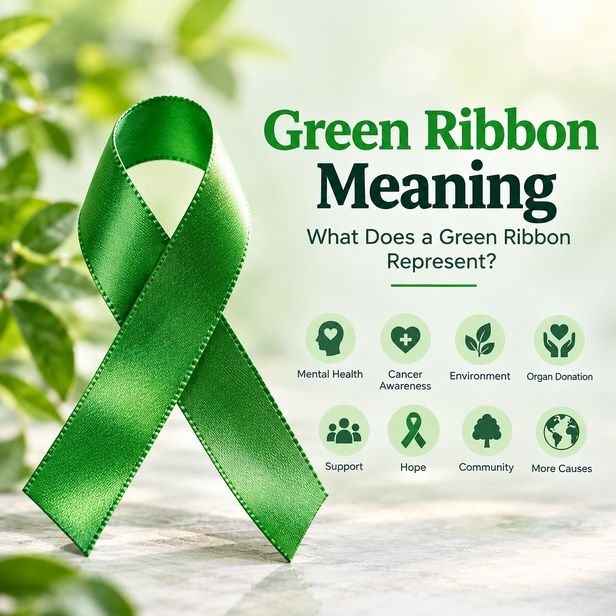
What Does a Green Ribbon Mean?
The Quick Answer
If you need a fast answer: solid green means mental health awareness, and that is the most formalized and internationally recognized use of the color. But green is not a proprietary symbol. The same color family carries different meanings depending on context. Lime green points toward lymphoma or Lyme disease; emerald or dark green toward liver cancer; light green toward STI, HPV, and celiac awareness. Green tied to a tree or placed in a horse’s tail is usually not an awareness ribbon at all.
Green Ribbon Meaning at a Glance
| Ribbon | Most reliable association | Key caveat |
|---|---|---|
| Solid green | Mental health awareness (international symbol) | Also used loosely for environment, community causes, and general hope |
| Lime green | Non-Hodgkin lymphoma (September) | Also used for Lyme disease and some childhood mental-health campaigns |
| Emerald / dark green | Liver cancer and liver disease | Not a universal “cancer” ribbon |
| Light green | STI awareness, HPV, celiac disease, chronic pelvic pain | Less standardized than lime green |
| Green + purple | Anal cancer awareness (March) | Formally chosen by the Anal Cancer Foundation |
| Blue + green | Neurofibromatosis (NF) awareness (May) | Not a mental-health ribbon |
| Green on a tree | Local memorial, environmental warning, or tree-preservation marking | Meaning depends entirely on the local organizer |
| Green in a horse’s tail | Young, inexperienced, or “green” horse—a safety signal | Not an awareness cause |
Why Context Matters
A single ribbon reference lists traditional green as supporting “over 40 different causes,” including spinal cord injuries, cerebral palsy, kidney disease, and glaucoma. That breadth is not confusion; it reflects how ribbon campaigns work. An organization adopts a color, publishes materials, and builds recognition within its own community. Another organization can later adopt the same color for a different cause, and both uses remain legitimate—but neither turns the color into a universal code. The organization and the occasion assign the meaning, not the color alone.
What Does a Green Ribbon Symbolize?
Hope and Renewal (General Cultural Symbolism)
Green carries broad cultural associations with spring, growth, vitality, and renewal. This is why green can appear in very different settings—from a memorial tree ribbon to a cancer pin—without contradiction. When green is used informally, “hope” or “support” is often the safest general reading. But general symbolism is not the same as a formal campaign meaning. A green ribbon on a backpack is not automatically an official mental-health pin; it may be a personal statement, a school color, or part of a local event.
Mental Health Awareness (Formal Organizational Use)
The green ribbon has achieved its widest formal recognition as a mental health symbol through the Mental Health Foundation in the UK. The Foundation calls it “the international symbol of mental health awareness” and encourages people to wear the pin “to create walking safe spaces for people to talk about mental health”. The symbol is used year-round, not limited to one month, and the Foundation promotes the hashtag #PinItForMentalHealth to encourage wearers to explain why they wear it. In Ireland, Shine’s Green Ribbon campaign uses the hashtags #GreenRibbonIRL and #EndTheStigma to reduce mental-health stigma.
Support, Solidarity, and Community Advocacy
Green is also used for community advocacy, fundraising, and visible solidarity. Examples include green ribbon campaigns organized by local businesses after tragedies, and green ribbons distributed by community groups to raise money for cerebral palsy research. In these settings, green functions as a unifying color rather than a nationally coded awareness symbol. The local organizer defines the message.
Environmental Awareness (Local and Campaign-Based)
Green’s environmental associations are strong, but they are expressed through local projects rather than a single national ribbon code. The Green Ribbon Project in Madison, Wisconsin, used green ribbons on ash trees to raise awareness of the emerald ash borer’s impact on the urban forest. Environmental advocates in Pangasinan, Philippines, used green ribbons carrying messages to protest tree cutting, with each ribbon symbolizing a commitment to protect trees as natural defenses against heat and flooding. These uses are organized, but they are not governed by one central authority. A green environmental ribbon in one town may not mean the same thing in the next.
The History of the Green Awareness Ribbon
The Origins of Awareness Ribbons
Awareness ribbons as we know them emerged from earlier ribbon traditions. In medieval Europe, ribbons were given as tokens of support or affection, and yellow ribbons became a symbol of remembrance for soldiers serving abroad. The modern awareness-ribbon movement crystallized in 1991, when the red ribbon was created by the Visual AIDS Artists Caucus, a New York–based group of artists and AIDS activists. The red ribbon’s success established the template: a looped ribbon worn visibly to signal support, remembrance, and a call for action.
How Green Became an Awareness Color
Green’s path to awareness-ribbon status was not the result of a single founding moment. Its cultural associations with renewal and life made it a natural choice for health and environmental causes, and different organizations adopted it independently. The Mental Health Foundation’s sustained campaign is the clearest example of green becoming a formalized awareness symbol: the Foundation built the green ribbon into a recognizable international identifier through consistent use, published materials, and a named campaign hashtag. Other green associations—such as liver cancer, lymphoma, and environmental projects—developed separately, which is why no single “origin story” can accurately explain all green ribbons.
How Green Ribbon Campaigns Have Evolved
Early awareness ribbons were primarily physical pins and loops. Modern green ribbon campaigns extend across social media, virtual stickers, landmark illuminations, and community installations. The Mental Health Foundation provides a virtual green ribbon for Instagram Stories alongside physical pins. The NF community illuminates buildings and monuments blue and green on May 17. Environmental groups tie ribbons to trees as visible, place-based advocacy. The ribbon remains the anchor, but the formats have multiplied.
What Does a Green Ribbon Mean Today?
Mental Health and Emotional Well-Being
Mental health remains the most visible contemporary green-ribbon meaning. The Mental Health Foundation’s Wear It Green Day, held during Mental Health Awareness Week (11–17 May in 2026), is a flagship fundraiser built around the color and the pin. The Foundation encourages year-round wear, not limited to the awareness week, and frames the ribbon as a conversation starter rather than a diagnostic label.
Cancer and Disease Awareness
Green’s disease associations are active but shade-specific. Non-Hodgkin lymphoma uses lime green in September; liver cancer uses emerald or dark green; light green covers STI, HPV, celiac, and chronic pelvic pain awareness. These campaigns operate independently, and a generic green ribbon in a health setting should not be assigned a specific disease without organizational confirmation.
Environmental Protection and Tree Advocacy
Environmental green-ribbon use is local and project-based. The Green Ribbon Project in Madison, Wisconsin, used green ribbons on ash trees to communicate the coming loss of urban tree canopy. In the Philippines, green ribbons carried protest messages against tree cutting. These campaigns show how green’s environmental symbolism is activated through place-based organizing rather than a universal ribbon code.
Community Advocacy, Fundraising, and Social Media
Green ribbons circulate through community fundraisers and social-media campaigns. A golf professional in British Columbia wore a green ribbon on his hat and launched a teach-a-thon that raised nearly $10,000 for mental-health initiatives. The Mental Health Foundation encourages supporters to post a photo explaining why they wear the ribbon with #PinItForMentalHealth. Irish mental-health campaigns use #GreenRibbonIRL and #EndTheStigma to extend the ribbon’s reach beyond physical pins.
What Does a Green Ribbon Mean for Cancer?
Green Cancer Ribbon Meaning: The Shade Is the Clue
There is no single cancer represented by “green.” Cancer ribbon practice is shade-specific, and treating green as one cancer color is the most common error in ribbon guides.
What Cancer Does a Green Ribbon Stand For?
| Shade | Cancer association | Awareness month |
|---|---|---|
| Lime green | Non-Hodgkin lymphoma | September |
| Emerald / dark green | Liver cancer and liver disease | — |
| Kelly green | Gallbladder / bile duct cancer | February |
| Green + purple | Anal cancer | March |
A plain, generic green ribbon in a cancer context—with no shade specification and no organization name—should not be assigned a specific cancer. It may be a general “cancer hope” ribbon in a local fundraiser, or it may be a mental-health ribbon that happens to appear at a cancer event. The responsible step is to look for a logo, event name, or caption before inferring a cancer type.
Green Ribbon Cancer Awareness vs. General Cancer Awareness
Cancer-specific green ribbons exist to distinguish one disease from another within the broader cancer-awareness landscape. Lime green for non-Hodgkin lymphoma and emerald green for liver cancer are not interchangeable. General cancer awareness is more often represented by lavender or a multicolor ribbon, not by solid green. If a campaign uses solid green without a shade qualifier, it is more likely a mental-health or general-hope ribbon than a cancer-specific one.
How to Identify the Specific Cancer Campaign
- Check the shade. Lime green and emerald green point to different cancers.
- Look for the organization’s name. NFCR, lymphoma organizations, and liver-cancer foundations use green differently.
- Check for a second color. Green paired with purple is an anal-cancer symbol, not a plain green lymphoma ribbon.
- Check the month. September (lymphoma), March (anal cancer), and February (gallbladder/bile duct) help narrow the context.
What Does a Light Green Ribbon Mean?
Light Green Ribbon Meaning
Light green is most consistently associated with sexually transmitted infection (STI) awareness, HPV, celiac disease, and chronic pelvic pain. Celiac awareness in May and STI awareness in April are two frequently cited examples. These are health-awareness uses, but they are distinct from lymphoma and mental health. Light green is less standardized than lime green, and the color name alone does not guarantee one single cause.
What Does a Lime Green Ribbon Mean?
Lime green has more specific published associations. Its primary cancer association is non-Hodgkin lymphoma (September). It is also used for Lyme disease awareness (May) and in some childhood mental-health campaigns, including childhood depression and mood disorders. A lime green ribbon can therefore point to lymphoma, Lyme disease, or a mental-health campaign depending on the organization and month.
Lime Green vs. Light Green Ribbons
Lime green is brighter and more yellow-shifted; light green is paler. In ribbon practice, lime green has a more stable cancer association (non-Hodgkin lymphoma), while light green is used more loosely across several health-awareness topics. Neither shade is a universal code. If the context is unclear, the sponsoring organization’s materials are the decisive source.
What Does a Dark Green Ribbon Mean?
Dark green and emerald green are often used interchangeably in cancer contexts. The most clearly documented association is liver cancer and liver disease. The color is sometimes explained as reflecting the liver as an organ and the color of bile, but that explanation is secondary to the organizational use. Dark green has also appeared in broader ribbon lists alongside other causes, but it does not carry a fixed psychological or medical meaning outside a specific campaign. Without a visible organization, a dark green ribbon should be read as “possibly liver-related” rather than definitively assigned.
What Does a Green and Purple Ribbon Mean?
A green and purple ribbon is the symbol for anal cancer awareness (March). The combination was formally chosen through a community vote organized by the Anal Cancer Foundation in 2013; purple and green won with 46% of the vote, and the Foundation published downloadable ribbon images in those colors. This is a formally adopted combination, not an arbitrary pairing.
How to Identify a Green and Purple Awareness Campaign
If you see green and purple together, check whether the context is anal-cancer awareness. In a cancer setting, that is the most specific published association. In a non-cancer setting, green and purple may appear together as part of a multicolor display representing multiple causes rather than a single combined symbol. The combination alone is not a universal code; the sponsoring organization’s name resolves the meaning.
What Do Other Green Ribbon Color Combinations Mean?
Blue and Green Ribbon Meaning
Blue and green is the ribbon for neurofibromatosis (NF) awareness, particularly in May. Blue and green are described as the two colors that represent NF globally, and the Children’s Tumour Foundation promotes a blue and green ribbon as a statement of support for people living with NF. The NF community also illuminates landmarks blue and green on and around May 17. This is not a mental-health ribbon.
Other Multicolor Green Ribbon Designs
Other green combinations exist but have lower search volume and less formal standardization. They are best treated as context-dependent rather than assigned fixed meanings in a universal chart. If you encounter a green multicolor ribbon that does not match the combinations above, look for the organization’s name before inferring a cause.
What Does a Green Ribbon Tied Around a Tree Mean?
Green Ribbons on Trees in Public Spaces
A green ribbon around a tree is a local signal, and its meaning depends on the people who tied it. Documented uses include:
- Memorial and remembrance: After the 2025 South Texas floods, residents of Alamo Heights tied green ribbons around trees and streetlights to honor those missing; green represented the official color of Camp Mystic and also carried associations of safety, renewal, harmony, and nature. In New Braunfels, green ribbons appeared on trees as “a sign of solidarity, remembrance and hope” for flood-affected communities.
- Environmental warning and tree preservation: In Madison, Wisconsin, neighborhoods marked ash trees with green ribbons to raise awareness of the emerald ash borer’s impact on the urban forest. In a widely reported case from British Columbia, a logger marked a massive old-growth Douglas fir with a green ribbon reading “Leave Tree,” using green to indicate a tree that should be spared from cutting.
- Environmental protest: In Pangasinan, Philippines, environmental advocates hung green ribbons with messages urging people to “save the trees,” each ribbon symbolizing a commitment to protect trees from cutting.
How to Identify a Tree Ribbon’s Meaning
There is no national “green tree ribbon meaning.” The only reliable method is local: look for a nearby sign, a social-media post from a community group, or someone to ask. A green ribbon on a tree is not automatically an awareness ribbon, and treating it as one can misread a memorial as a health campaign—or vice versa.
What Does a Green Ribbon in a Horse’s Tail Mean?
In equestrian settings, a green ribbon in a horse’s tail is a safety convention, not an awareness ribbon. It indicates that the horse is young, inexperienced, or “green”—either a young horse still in training or an inexperienced one that may be unpredictable. Riders and handlers are expected to approach with caution and give the horse extra space. The signal is recognized in equestrian practice alongside other tail-ribbon codes: red for a horse that may kick, blue for a stallion, and pink for a mare in season. A green horse-tail ribbon should never be interpreted as a statement about mental health, cancer, or any public-health cause. It is a functional warning tied to the horse’s training stage.
How to Tell What a Green Ribbon Means
When you see a green ribbon—in person, on social media, or in a photograph—use this four-step method.
Step 1: Check the organization or campaign. A green ribbon distributed by the Mental Health Foundation, a lymphoma organization, a liver-cancer foundation, or an NF group carries the meaning that organization assigns. The Mental Health Foundation’s pin and the Children’s Tumour Foundation’s blue-and-green NF ribbon are clear examples of organization-defined meaning.
Step 2: Look for text or a logo. A pin card, event banner, or caption almost always resolves the cause. “Green ribbon” alone does not.
Step 3: Consider the location and occasion. A ribbon on a tree after a local tragedy, a ribbon at a workplace mental-health event, and a ribbon in a horse’s tail at a competition are three different kinds of signal. The setting is part of the message.
Step 4: Check the shade and any second color. Lime green, emerald green, light green, green-and-purple, and blue-and-green each narrow the possibilities. If the shade is generic green and there is no second color or text, do not assume a specific disease.
How to Wear a Green Awareness Ribbon
How to Wear a Green Ribbon Pin
The most common formal format is a lapel pin or badge. The Mental Health Foundation encourages wearing the green ribbon pin as a conversation starter and as a signal that you are approachable. There is no single universal placement rule across all campaigns; follow the format provided by the organization whose cause you support.
When to Wear a Green Ribbon
Mental Health Awareness Week (May), Mental Health Month (May in some regions), lymphoma awareness in September, and NF awareness in May are common periods when specific green meanings are especially visible. The Mental Health Foundation encourages year-round wear for mental health, and Irish campaigns use the ribbon beyond a single month. Matching the shade and timing to the campaign you intend to support prevents confusion.
How to Support a Campaign Respectfully
If you are supporting a specific cause, use that campaign’s materials and color specifications. A generic green ribbon worn at a lymphoma event may be read as mental-health support; a lime green ribbon at a mental-health event may be read as lymphoma awareness. On social media, state the cause alongside the ribbon. The Mental Health Foundation’s #PinItForMentalHealth asks wearers to explain why they wear the pin, and Shine’s #GreenRibbonIRL and #EndTheStigma frame the ribbon as part of a broader anti-stigma message.
Green Ribbon Meaning — Quick Reference Chart
| Ribbon / shade | Most reliable association | Possible ambiguity | How to verify |
|---|---|---|---|
| Solid green | Mental health awareness | Environment, community causes, general hope | Check for Mental Health Foundation or campaign branding |
| Lime green | Non-Hodgkin lymphoma (September) | Lyme disease, childhood mental health | Check month and organization |
| Emerald / dark green | Liver cancer / liver disease | Generic “cancer hope” in some local settings | Check for liver-cancer foundation materials |
| Light green | STI, HPV, celiac, chronic pelvic pain | Less standardized than lime green | Look for event or organizational materials |
| Green + purple | Anal cancer (March) | Multicolor displays of multiple causes | Check for Anal Cancer Foundation materials |
| Blue + green | Neurofibromatosis (May) | Not a mental-health ribbon | Check for Children’s Tumour Foundation or NF campaign |
| Green on a tree | Local memorial, environmental warning, preservation marking | Not a national awareness code | Ask locally or look for a sign or post |
| Green in a horse’s tail | Young or inexperienced horse—safety signal | Not an awareness cause | Recognize equestrian context |
Frequently Asked Questions
Why do two different causes sometimes use the same green ribbon?
Ribbon colors are not governed by a central authority. Organizations adopt colors independently, and recognition is built within each community. The sponsoring organization—not the color—is the authoritative source for meaning.
Does a green ribbon always mean mental health awareness?
No. Mental health is the most formalized use, but the same color appears in cancer campaigns, light-green health topics, environmental projects, and local memorials. A generic green ribbon with no organizational context should not be assumed to be a mental-health pin.
Is there a difference between a green ribbon and a green awareness ribbon?
“Green awareness ribbon” usually implies a cause-related campaign, but “awareness” is not a protected term. A green ribbon worn informally may carry personal or local meaning rather than an official awareness message. The presence of campaign materials, a logo, or an event name is what distinguishes an awareness ribbon from an everyday green ribbon.
Final Thoughts
The most useful thing to know about a green ribbon is not a single definition but a reading method: check the shade, check for a second color, check the organization, and check the occasion. Green is a shared color, not a proprietary symbol, and the communities that use it have built distinct meanings around it—from the Mental Health Foundation’s international mental-health pin to lymphoma’s lime green, liver cancer’s emerald, NF’s blue-and-green, and the local, place-based meanings of a ribbon on a tree or in a horse’s tail. When you read the context, the ribbon becomes informative; when you ignore the context, it becomes a guess.
For more color-specific guides, explore Seek Ribbon’s other awareness-ribbon breakdowns.