

If you make homecoming mums for a living, you already know the shelf is gone. In August 2025, Hobby Lobby confirmed it would no longer carry homecoming mum supplies in any of its locations, closing a retail channel that many small makers had relied on for years. The reasons are not mysterious: Berwick-Offray, the ribbon company behind the acetate used in roughly 70% of homecoming mums, closed its production facility in 2025, and Lion Ribbon, another major domestic distributor, filed for bankruptcy and liquidated its woven ribbon business.
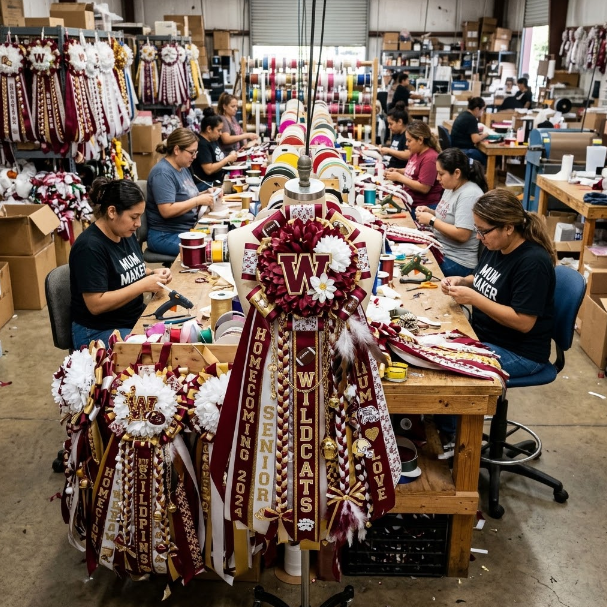
A disappearing retail shelf is not the same thing as a disappearing ribbon. What has changed is the sourcing path. The question is no longer “which store carries it.” It is: which wholesale channel fits your production volume, your color requirements, and your tolerance for cost volatility. This guide breaks that decision into the three channel types professional mum makers are actually using in 2026 — and then explains what to verify before you place a bulk order.
What Changed, and Why It Is Not Going Back
The Hobby Lobby exit was not a temporary category reset. It was the retail-level symptom of a structural break upstream. Berwick-Offray’s closure removed a domestic acetate supply base that had served the mum trade for decades. Lion Ribbon’s liquidation removed another layer of domestic woven ribbon capacity. The cost effect is now measurable at the bench: makers report paying 33–35% more for ribbon after switching suppliers, and some have absorbed a $30 increase in the cost to produce a single mum.
A custom mum can consume 100 to 200 yards of specialty ribbon, and ribbon is already the largest single supply cost in a mum business. When the retail channel vanishes and two domestic suppliers exit at once, the makers who feel it first are the ones still buying in small, reactive increments. The makers who stabilize are the ones who move to a channel where volume, fiber specification, and pricing can be locked in before the season starts.
The Three Wholesale Channels, and Who Each One Actually Fits
Not every mum maker should buy the same way. A studio producing 30–35 mums a year and a shop producing several hundred have different thresholds for minimum order quantities, storage capacity, and customization needs. The three channels below are not ranked by “best” — they are ranked by fit.
Channel 1: General Wholesale Ribbon Distributors
The two names most professional mum makers still reference are Reliant Ribbon and McGinley Lion. Reliant has supplied wholesale ribbon to the floral, craft, and packaging trades since 1963 and offers a dedicated homecoming ribbon selection in 100-yard rolls. McGinley Lion is the other legacy name, though its wholesale account structure can be more restrictive depending on the product line — some gold-label products must be purchased through an approved vendor rather than directly.
Fit: Established makers who need a broad in-stock color range, are already set up with a sales tax permit and wholesale account, and value the ability to order multiple ribbon categories from one source.
Trade-off: You are buying through an intermediary layer. In a market where acetate costs are already moving, distributor pricing carries the overhead of that layer. In-season stockouts on high-demand school colors are a real risk, and the account setup itself is a gate that newer makers may not yet clear.
Channel 2: Homecoming-Specific Wholesale Suppliers
A second channel has grown into the space Hobby Lobby vacated: suppliers whose entire catalog is built around the mum and garter trade. L&M Wholesale and Mum Factory Outlet are the clearest examples. These suppliers stock the #9 and #16 widths that dominate mum braiding and loops, often in 100-yard rolls, and they understand the seasonal rhythm of the business in a way a general craft distributor does not.
Fit: Makers who want a focused catalog, predictable width numbering, and a supplier that already speaks the language of “white #9” rather than asking you to translate inches into a product SKU.
Trade-off: The catalog depth is narrower. If you also supply floral arrangements or general craft ribbon outside the mum season, you will likely need a second account to cover those categories. Custom color matching is not universally available at this tier, so school-specific shades may still require a separate arrangement.
Channel 3: Direct from the Manufacturer (Seek Ribbon)
The third channel is the one that changes the cost structure rather than just the supplier name. Buying directly from an acetate ribbon manufacturer removes the distributor markup and, in the right setup, allows you to lock per-roll pricing across a production season instead of absorbing whatever the wholesale market does mid-season.
This channel is not the right answer for every reader. If your annual ribbon consumption is under roughly 15 rolls, the minimum order thresholds and freight economics of direct manufacturing may not beat a general distributor’s landed cost. But for a studio or shop with a stable season and a defined color palette, direct manufacturing offers two things the other channels cannot: transparent volume pricing and custom color matching at a workable minimum.
| Channel | Typical entry threshold | Price predictability | Custom color flexibility | Best fit |
|---|---|---|---|---|
| General wholesale distributor | Wholesale account + tax permit | Moderate — tracks market movement | Low — catalog colors only | Established makers needing broad in-stock range |
| Homecoming-specific supplier | Moderate — focused SKU set | Moderate | Limited — some offer school-color matching | Makers wanting a dedicated mum catalog |
| Direct manufacturer (SeekRibbon) | Volume-based (e.g. 10+ rolls) | High — tiered rates published up front | High — low-minimum custom dyeing | Studios and shops with a defined seasonal volume |
What Actually Determines Your Ribbon Cost (Beyond the Per-Roll Price)
Once you choose a channel, the next layer of cost control is specification discipline. Three variables quietly separate a stable supply relationship from a season of reorders and rejects.
Confirm the fiber, not just the word “satin”
This is the single most common specification error in mum ribbon sourcing. Satin is a weave, not a fiber. An acetate satin ribbon and a polyester satin ribbon can look nearly identical on a shelf, but they behave differently at the bench. Polyester satin is soft and fluid — it knots easily and drapes naturally. Acetate is stiffer, flatter, and more rigid; it holds a fold and keeps a large bow upright through a full day of wear. A polyester bow will sag. An acetate bow stays shaped.
For a mum maker, this is not a stylistic preference. It is a functional requirement. If a supplier lists “satin ribbon” or even “satin acetate” without stating the fiber composition, you may be buying polyester or a blend without knowing it. A written 100% acetate specification on the purchase order is the minimum protection against a substitution that only becomes visible after the bows are built.
Calculate landed cost per mum, not price per roll
A low roll price can still produce a high cost per finished mum if the roll length, width, or fiber does not match how you actually cut and braid. Professional buying conversations use the florist width numbering system: #5 corresponds to roughly ⅞″, #9 to roughly 1⅜″, and #40 to 2½″–3″. Buying the wrong number for your braid pattern creates waste that erases any per-roll savings.
The working calculation is: roll price + freight + cutting waste + storage cost + the risk premium of an in-season stockout. A 100-yard roll at a slightly higher per-yard rate can be the cheaper input if it matches your width usage and eliminates a mid-season emergency reorder at spot pricing.
Ask how batch-to-batch color consistency is controlled
For makers filling school orders or producing in batches, a shade shift between two rolls of the same nominal color is a delivery risk, not an inconvenience. It is worth asking a potential supplier, before the first bulk order, how they handle dye-lot consistency and whether they can supply swatch cards from the same production batch. A supplier that cannot answer that question in concrete terms is a supplier that has not built its process around B2B buyers.
How SeekRibbon Makes “Wholesale” Predictable
The reason direct manufacturing deserves a serious look in 2026 is not that intermediaries are bad. It is that the intermediate layer is exactly where cost volatility gets amplified when upstream supply is unstable. As a manufacturer selling directly, SeekRibbon can expose the pricing structure instead of hiding it inside a distributor margin.
In practice, that means three concrete mechanisms a B2B buyer can evaluate:
1. Transparent volume tiers. You can see the per-roll rate at 10–49 rolls and at 50+ rolls, and model your season against both before committing. The rate is published, not negotiated blind.
2. Custom color matching at a defined minimum. Instead of buying 100 rolls of a standard color to get one school-specific shade, you can order the custom shade at a stated minimum and keep your inventory aligned with actual demand.
3. A physical swatch card before the bulk order. Ribbon is a hand-feel and sheen product. A swatch card from SeekRibbon lets you verify stiffness, edge finish, and color against your current stock before committing to a season’s supply — the lowest-cost risk reduction available in this category.
Send us your annual roll count and width mix and we will return a written wholesale quote. Still comparing sources? Request a physical swatch card and judge the acetate for yourself.
Frequently Asked Questions
No. Satin describes a weave, not a fiber. Acetate satin is stiff and holds its shape, which is why it is the standard for braided mums and structured bows. Polyester satin is softer and drapes, making it a poor choice for bows that need to stay upright all day.
Most braiding and loop work uses #9 (roughly 1⅜″) and #16, while #40 (2½″–3″) is common for streamers and large background bows. SeekRibbon stocks these widths in 100-yard, 100% acetate rolls.
SeekRibbon publishes tiered pricing starting at 10 rolls, with a lower per-roll rate at 50+ rolls. Custom color matching is available at a defined low minimum, so you do not need to overstock standard colors to access a school-specific shade.
Yes. Send a physical color reference or a Pantone number and we will confirm the closest match and the minimum quantity before production begins.
The Short Version for a Busy Maker
The big-box channel is gone, and the two domestic suppliers that once anchored the category have restructured or exited. The replacement is not a single store. It is a choice between a general wholesale distributor, a homecoming-focused supplier, and a direct manufacturer — each with a different minimum, a different level of color flexibility, and a different exposure to mid-season price movement. The makers who stabilize their 2026–2027 seasons will be the ones who specify 100% acetate in writing, buy in the width numbers their braids actually use, and lock pricing before the season rather than after the first stockout.