

In This Guide
- What Is Stitch Ribbon?
- Different Types of Stitch Ribbon
- Special Stitch Effects and Color Combinations
- Common Materials Used in Stitch Ribbon
- Popular Applications of Stitch Ribbon
- How to Choose the Right Stitch Ribbon
- What Buyers Should Check When Sourcing Wholesale
- Custom Stitch Ribbon Manufacturing
- Frequently Asked Questions
- Conclusion
Stitch ribbon is a decorative ribbon featuring visible stitching, embroidery, or thread details that add texture and character to its surface or edges. Unlike plain satin or grosgrain ribbon, stitched ribbon combines the appearance of a traditional ribbon with an additional decorative element created by thread.
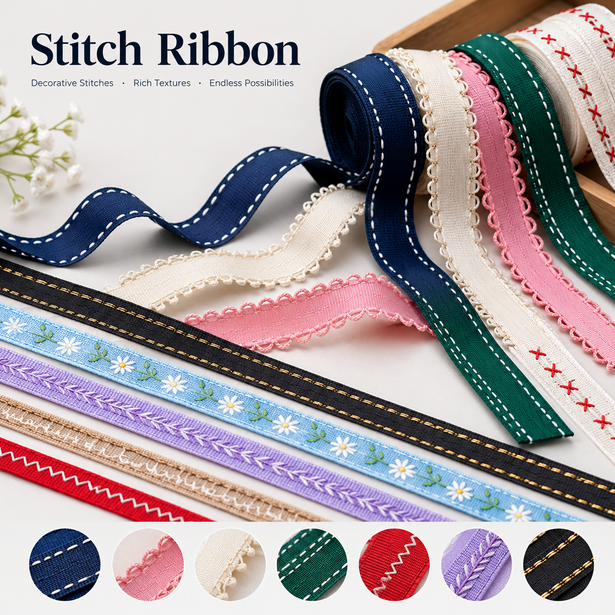
From classic saddle stitch grosgrain ribbon to distinctive moonstitch ribbon, these designs are used in gift packaging, fashion accessories, hair bows, crafts, and other decorative applications.
For brands, wholesalers, packaging companies, and product manufacturers, understanding the different stitch styles is important when selecting ribbon for a specific product or developing a custom design.
This guide explains what stitch ribbon is, introduces popular styles, compares common materials, and outlines the key factors to consider when sourcing stitched ribbon wholesale.
1. What Is Stitch Ribbon?
Stitch ribbon is a broad descriptive term for ribbon decorated with visible stitching or embroidery details. These details may appear along the edges, across the ribbon surface, or as repeated decorative patterns.
The stitching can be created using different thread colors, stitch arrangements, and decorative techniques. Depending on the design, it may produce a subtle tailored appearance or a more noticeable textured effect.
How Is Stitch Ribbon Different from Regular Ribbon?
The main difference is the additional decorative thread detail.
| Feature | Regular Ribbon | Stitch Ribbon |
|---|---|---|
| Surface design | Usually plain or woven-patterned | Includes visible stitching or embroidery |
| Appearance | Clean and simple | Textured and decorative |
| Design options | Color, weave, print, and finish | Thread color, stitch pattern, and placement |
| Typical applications | Packaging, apparel, crafts | Premium packaging, accessories, apparel, and crafts |
Stitch ribbon is not a single base material. It can be made with grosgrain, satin, cotton, or other suitable ribbon fabrics, depending on the intended appearance and application.
It is also important to distinguish stitched ribbon from ribbons that simply have a cut, woven, or shaped decorative edge. A genuine stitched design should feature a visible thread-based decorative element.
2. Different Types of Stitch Ribbon
Stitch ribbon designs are not always classified using one universal industry naming system. Some names describe a recognizable commercial product, while others refer to the appearance or construction of a particular stitch.
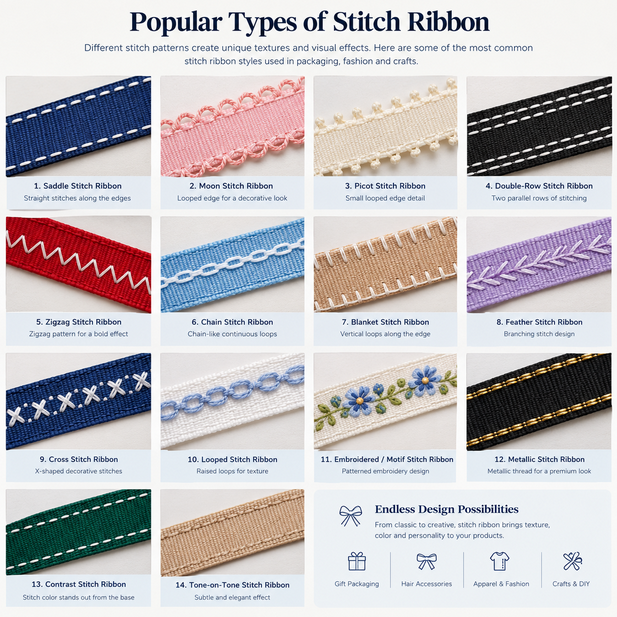
The following styles are useful starting points when exploring decorative stitched ribbons.
2.1 Saddle Stitch Ribbon
Saddle stitch ribbon is one of the recognizable styles in the decorative ribbon market.
It typically features one or two rows of contrasting stitches running parallel to the ribbon edges. The stitching creates a neat, tailored appearance that resembles decorative topstitching on leather goods or apparel.
A common commercial version combines polyester grosgrain ribbon with white stitching along both edges. Other combinations use dark thread on a light ribbon or matching thread for a more understated effect.
Common characteristics:
- Straight, evenly spaced decorative stitches
- One or two rows positioned near the edges
- Contrasting or tone-on-tone thread colors
- Frequently paired with grosgrain ribbon
Typical applications:
- Gift boxes and retail packaging
- Boutique product presentation
- Hair bows and accessories
- Apparel trims
- Invitations and craft projects
Saddle stitch ribbon works particularly well when a product needs a clean, structured decorative detail without an overly elaborate pattern.
2.2 Moonstitch Ribbon
Moonstitch ribbon, also written as moon stitch ribbon or moonstitch edge ribbon, is known for its distinctive decorative stitching along the edges.
Unlike the straight rows found on saddle stitch ribbon, moonstitch designs commonly feature repeated loops or rounded stitch details that create a soft, scallop-like visual effect.
Many retail products use grosgrain as the base ribbon. The decorative edge gives the ribbon a more playful and textured appearance, making it popular in hair accessories and boutique-style craft projects.
Common characteristics:
- Repeated looped or rounded edge stitching
- A textured, decorative border
- Often made with grosgrain ribbon
- Available in contrasting or coordinated color combinations
Typical applications:
- Hair bows and children’s accessories
- Boutique packaging
- Scrapbooking and handmade crafts
- Decorative ribbon boards
- Sewing and accessory projects
When sourcing moonstitch ribbon, buyers should examine the actual stitch construction rather than relying on the product name alone. Some listings use terms such as scalloped edge, looped edge, or crocheted edging to describe a similar visual appearance.
A shaped or scalloped ribbon edge without decorative thread construction should not automatically be classified as moonstitch ribbon.
2.3 Double-Row Stitch Ribbon
Double-row stitch ribbon describes a design with two parallel lines of decorative stitching.
Depending on the construction, the rows may be positioned near the edges or placed closer together across the ribbon surface.
This design can create a more structured appearance than a single stitch line. Contrasting thread can make the stitching more visible, while matching thread produces a subtle finish.
Design possibilities include:
- Two rows of white stitching on navy grosgrain
- Matching thread on a neutral cotton ribbon
- Two contrasting thread colors
- Different stitch spacing for a customized appearance
The exact stitch construction and commercial product name should be confirmed with the manufacturer before placing an order.
2.4 Other Decorative Stitch and Embroidery Designs
Beyond recognizable commercial styles such as saddle stitch and moonstitch, decorative ribbon can also incorporate other thread-based designs.
Depending on the equipment and construction method, these may include:
- Zigzag stitching
- Chain-like stitch patterns
- Cross-stitch-inspired motifs
- Repeated loop patterns
- Decorative embroidered flowers, symbols, or small motifs
These descriptions refer to possible design effects rather than a universally standardized list of stitch ribbon product categories.
For buyers developing a custom ribbon, reference photographs or physical samples are often more useful than relying on a stitch name. They help the manufacturer understand the desired thread arrangement, pattern scale, and overall appearance.
3. Special Stitch Effects and Color Combinations
The decorative thread itself can significantly change the appearance of stitched ribbon. Even when the stitch construction remains the same, different thread colors and finishes can create very different visual results.
Contrast Stitching
Contrast stitching uses a thread color that stands out against the base ribbon.
Examples include:
- White stitching on black grosgrain
- Red stitching on ivory ribbon
- Navy stitching on white ribbon
- Gold stitching on dark green ribbon
This approach is suitable for brands that want the decorative detail to be visible from a distance.
Tone-on-Tone Stitching
Tone-on-tone stitching uses a thread color that closely matches the base ribbon.
For example, dark navy thread on navy grosgrain creates a subtle textured effect without introducing a strong color contrast.
This style works well for understated packaging, premium accessories, and coordinated apparel details.
Metallic Thread Details
Metallic thread can introduce a decorative shine to stitched ribbon.
Gold and silver are common visual choices for festive packaging, holiday decorations, and special-occasion products.
When selecting metallic thread, buyers should confirm its appearance, flexibility, and durability through sampling, especially if the ribbon will be tied into bows or sewn into finished products.
4. Common Materials Used in Stitch Ribbon
The base ribbon material affects the texture, appearance, flexibility, and suitability of the finished product. The decorative thread is a separate material choice and should also be considered.
Polyester Grosgrain
Polyester grosgrain is a popular base for decorative stitched ribbon.
Its ribbed surface provides a structured appearance, while its shape retention makes it suitable for bows, accessories, and packaging decoration.
It is commonly used for saddle stitch and moonstitch-style designs.
Polyester Satin
Satin ribbon offers a smooth surface and a subtle sheen. When combined with decorative stitching, it can create a more elegant appearance.
It may be suitable for premium gift packaging, fashion accessories, and branded presentation.
Cotton Ribbon
Cotton ribbon has a natural texture and a softer, less glossy appearance than polyester satin.
It can be considered for brands looking for a natural-looking decorative trim, particularly in clothing, handmade products, and selected packaging applications.
Blended Materials
Some projects may require a blend of fibers to balance appearance, texture, and performance.
The exact material composition should be confirmed before production, particularly when the ribbon must meet specific product, labeling, or sustainability requirements.
| Base Material | Appearance | Potential Applications |
|---|---|---|
| Polyester grosgrain | Ribbed and structured | Hair bows, packaging, accessories |
| Polyester satin | Smooth and slightly glossy | Premium packaging, fashion accessories |
| Cotton | Natural and soft | Apparel, crafts, natural-style packaging |
| Fiber blends | Depends on the blend | Customized decorative applications |
Buyers should request the material composition and relevant test information rather than assuming that all ribbons with a similar appearance have the same fiber content.
5. Popular Applications of Stitch Ribbon
Stitched ribbon can serve both decorative and functional purposes. The right style depends on the product, target market, and desired visual effect.
Gift Packaging and Luxury Branding
Decorative stitching can add detail to gift boxes, paper bags, product bundles, and retail packaging.
For brands that want to create a distinctive packaging identity, thread color and stitch placement can complement existing brand colors and packaging materials.
Hair Accessories and Boutique Products
Grosgrain-based stitched ribbon is frequently used in hair bows, clips, headbands, and other accessories.
Saddle stitch offers a clean, classic appearance, while moonstitch designs provide a more textured edge.
Apparel and Garment Trims
Stitched ribbon can be incorporated into garments as decorative trim, waist details, ties, or other design elements.
For apparel applications, buyers should pay attention to softness, flexibility, washing performance, and colorfastness. The ribbon should be tested in conditions similar to its intended use.
Floral and Craft Applications
Decorative stitched ribbon can also be used in bouquets, handmade cards, scrapbooking, seasonal decorations, and DIY projects.
Different widths and stitch designs allow makers to create varied decorative effects without changing the basic ribbon material.
6. How to Choose the Right Stitch Ribbon
Selecting the right stitched ribbon involves more than choosing a color. Buyers should consider the construction, material, dimensions, and performance requirements of the finished product.
1. Choose the Stitch Design
Start with the desired visual effect.
- Choose saddle stitch for a clean, tailored appearance.
- Choose moonstitch for a decorative looped edge.
- Consider other embroidered or stitched motifs for more distinctive designs.
If the required style has a specific appearance, provide a photograph or physical sample to the supplier.
2. Select the Base Material
Consider whether the project requires the structured feel of grosgrain, the smooth surface of satin, or the natural texture of cotton.
The material should match both the appearance and performance requirements of the final application.
3. Confirm the Ribbon Width
Ribbon width affects the visibility of the stitching and the overall proportions of the design.
Narrow ribbon may be suitable for small accessories and garment details, while wider ribbon provides more space for decorative patterns and packaging applications.
Always confirm the finished width, including any decorative edge construction if relevant.
4. Select the Thread Color
Thread color can be matched to the base ribbon for a subtle finish or selected in a contrasting shade for greater visibility.
For brand-specific projects, provide a physical color reference or an agreed color standard. Digital images may not accurately represent the final color.
5. Check Stitch Quality
Before approving bulk production, inspect:
- Stitch spacing and consistency
- Thread tension
- Loose threads or skipped stitches
- Stitch alignment along the ribbon
- Edge appearance
- Color consistency between rolls
For ribbons used in apparel or frequently handled accessories, buyers should also consider how the stitching performs during sewing, tying, and repeated use.
6. Consider the Final Application
A ribbon used for gift packaging may have different requirements from one sewn into clothing.
For example, apparel applications may require additional testing for washing, friction, and colorfastness. Packaging applications may place greater emphasis on appearance, roll consistency, and presentation.
7. What Should Buyers Check When Sourcing Stitch Ribbon Wholesale?
For importers, wholesalers, and product manufacturers, choosing a supplier involves evaluating both product quality and production reliability.
Here are several important points to confirm before ordering.
| Purchasing Factor | What Buyers Should Confirm |
|---|---|
| Stitch design | Exact stitch appearance, placement, and construction |
| Base material | Fiber composition and ribbon construction |
| Width | Finished width and dimensional consistency |
| Thread color | Available colors and custom matching options |
| Stitch quality | Spacing, tension, alignment, and loose threads |
| Roll length | Standard and customized roll lengths |
| MOQ | Minimum order quantity for stock and custom designs |
| Lead time | Sample development and bulk production schedule |
| Packaging | Individual rolls, labels, cartons, and export packing |
Request Samples Before Bulk Production
A sample is one of the most effective ways to confirm whether the ribbon meets your expectations.
It allows buyers to check the actual material, stitch appearance, thread color, flexibility, and overall workmanship.
For custom projects, approve a production sample before authorizing the full order.
Confirm Customization Details
If the project requires a specific design, provide as much information as possible:
- Base ribbon material
- Ribbon width
- Base ribbon color
- Stitch pattern or reference photograph
- Thread color
- Required roll length
- Estimated order quantity
- Intended application
Clear specifications help reduce misunderstandings during sample development and production.
8. Custom Stitch Ribbon Manufacturing
Custom stitched ribbon can help brands create a more distinctive product appearance than standard decorative ribbon.
Depending on the manufacturer’s equipment and production capabilities, customization may involve the base ribbon, thread color, stitch arrangement, width, and packaging.
A typical custom development process includes the following steps:
Step 1: Share Your Requirements
Provide your preferred ribbon material, width, base color, stitch design, and intended application.
Step 2: Review Design Feasibility
The manufacturer evaluates whether the requested construction can be produced using the available equipment and materials.
Step 3: Develop a Sample
A sample is prepared to demonstrate the actual ribbon appearance and stitching details.
Step 4: Approve the Sample
Check the material, dimensions, thread color, stitch consistency, and overall finish.
Step 5: Bulk Production
After sample approval, the order proceeds according to the confirmed specifications and production schedule.
Step 6: Quality Inspection and Packing
The finished ribbon should be inspected against the approved sample before packing and shipment.
For wholesale projects, it is important to confirm MOQ, sampling costs, production lead time, and packaging requirements with the supplier before placing an order.
9. Frequently Asked Questions About Stitch Ribbon
Is stitch ribbon machine washable?
It depends on the base material rather than on the stitching itself. Polyester grosgrain and satin generally tolerate gentle hand washing or a cold, delicate machine cycle, while cotton ribbon may be machine washed but can shrink or soften. Metallic threads are the most sensitive and may tarnish or lose their shine after repeated washing. For apparel and accessories, always test a small piece first and follow the care instructions of the finished garment.
Does the decorative stitching affect the ribbon’s price?
Yes. Stitching adds a secondary manufacturing step: a separate thread, additional machine time, and tighter quality control for alignment and tension. Ribbons with dense embroidery, metallic thread, or multi-row patterns typically cost more than simple single-row saddle stitch designs. At wholesale volumes the difference is usually modest, but custom thread colors and complex patterns can increase both the unit price and the minimum order quantity.
Can stitch ribbon be printed with a brand logo?
Usually not directly over the stitching. Most manufacturers print or dye the base ribbon before the stitching is applied, and the thread can interrupt or distort a printed design. If you need a branded ribbon, more practical options include matching the thread color to your brand palette, choosing a custom base color, or pairing a plain ribbon with a woven label or printed tag.
What widths are typically available?
Common stock widths range from roughly 3 mm to 38 mm, with 10 mm, 16 mm, 22 mm, and 25 mm being the most widely used for hair bows, packaging, and apparel trims. Wider formats of 38 mm and above are available but may limit how many stitch rows fit comfortably. Narrow widths under 10 mm usually work best with a single stitch line.
Will the cut ends of stitch ribbon fray?
Yes. Most woven ribbons, including grosgrain and cotton, will fray at the cut edge unless they are heat-sealed or otherwise finished. Edge stitching does not prevent fraying, because the decorative thread sits on the surface rather than sealing the weave. For packaging, a clean diagonal cut or a heat-sealed end is usually enough; for apparel and accessories, fold the end under or apply a small amount of fray-check.
Can stitch ribbon be used outdoors?
It is not generally recommended for prolonged outdoor exposure. Polyester base ribbons resist moisture better than cotton, but continuous UV exposure can fade both the ribbon and the thread, and metallic threads may tarnish. For outdoor or high-humidity uses, choose a polyester base with colorfast thread and test a sample under realistic conditions before committing to bulk.
How should stitched ribbon be stored?
Keep rolls wound on their original cores and store them flat or on a horizontal rack, away from direct sunlight, heat, and moisture. Loose ribbon should be rolled rather than folded, since sharp creases can distort the stitch line and be difficult to press out. In humid climates, a sealed container with a desiccant helps protect both the base fabric and the thread.
10. Conclusion
Stitch ribbon combines the familiar structure of traditional ribbon with decorative thread details, creating more opportunities for product styling, packaging, and accessory design.
Saddle stitch and moonstitch are two recognizable styles, while other stitched and embroidered effects can be explored for custom projects.
For wholesale buyers, the most important considerations are the actual stitch construction, base material, thread color, workmanship, and consistency between samples and bulk production.
Whether you are sourcing decorative ribbon for retail packaging, hair accessories, apparel, or craft products, working with a supplier that understands both ribbon materials and decorative construction can help you develop a product that meets your design and purchasing requirements.