

📑 Table of Contents
- What Is Twill Tape?
- Is Twill Tape the Same as Twill Ribbon?
- Why Is It Called “Twill Tape”?
- What Is Twill Tape Used For?
- What Is Twill Tape Used For in Sewing?
- What Is Cotton Twill Tape?
- Types of Twill Tape
- Twill Tape vs. Bias Tape
- What Can I Use Instead of Twill Tape?
- Twill Tape in Garments
- How to Choose the Right Twill Tape
- Twill Tape Specifications Buyers Should Confirm
- What Is the HS Code for Twill Tape?
- Frequently Asked Questions
Twill tape is a narrow, flat woven textile tape made with a twill construction. It is commonly used for sewing, garment reinforcement, binding, ties, loops, and textile accessories. You may also see it called twill ribbon, although the two terms can emphasize different applications.
This guide is written from a manufacturer’s perspective. Whether you are a garment producer sourcing reinforcement tape, a procurement manager confirming specifications, or a sewist trying to understand what to buy — the goal here is to answer the questions that actually matter when specifying, purchasing, or using twill tape.
What Is Twill Tape?
Twill tape is a strong woven fabric tape made in a twill weave, most often used as button or seam reinforcement in garment construction, though it is also used for binding edges and as ties or closures. It may be made from a variety of natural and artificial fibers.
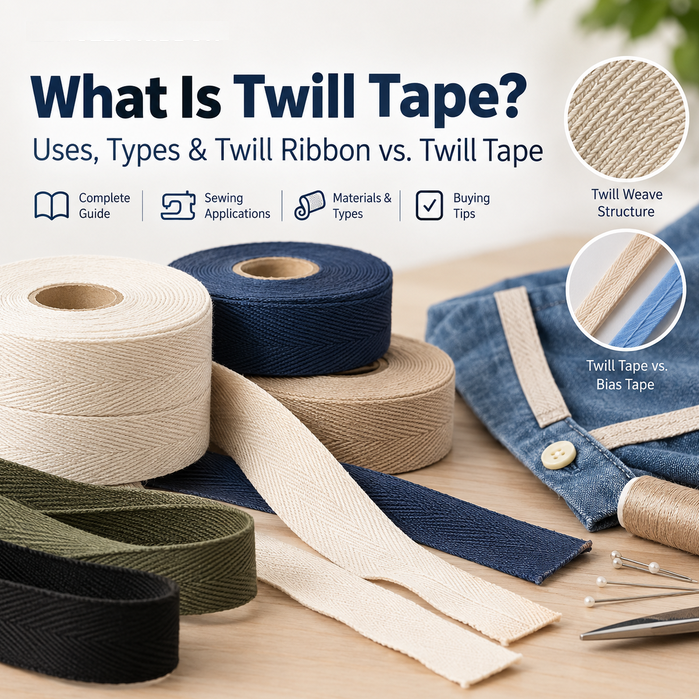
The key characteristics of twill tape include:
- Flat, narrow woven structure — typically produced in widths from 6 mm to 50 mm
- Diagonal surface texture — the visible “rib” that distinguishes it from plain-weave tapes
- Low stretch — unlike bias tape, twill tape is dimensionally stable, which is precisely why it works for stabilization and reinforcement
- Woven edges — the selvedges are finished during weaving, so the tape does not unravel easily
Twill tape is light in weight, soft, and can be stitched directly onto garments. It is available in both bleached and unbleached forms, and can be dyed into custom colors.
Is Twill Tape the Same as Twill Ribbon?
In many textile and ribbon markets, “twill tape” and “twill ribbon” refer to essentially the same type of narrow woven material. The terminology typically reflects the intended application rather than a fundamentally different construction.
| Term | Usually emphasizes | Typical context |
|---|---|---|
| Twill tape | Functional / sewing use | Garments, reinforcement, binding |
| Twill ribbon | Ribbon / decorative use | Craft, packaging, trim |
| Cotton twill tape | Material | Apparel, sewing, natural-fiber applications |
| Polyester twill tape | Material / performance | Durable industrial or garment applications |
Industry sources confirm this overlap. Twill tapes are described as “fabric tapes, which are also known as twill ribbons,” and they can be made from cotton, polyester, or other fibers depending on the application. In practice, tape and ribbon are used interchangeably across suppliers and countries — there is no strict product classification standard that separates them. The naming convention is driven by how the product is marketed and used, not by a different manufacturing process.
Why Is It Called “Twill Tape”?
The name breaks into two parts, each describing a different aspect of the product:
Twill refers to the weave structure, not the fiber. In a twill weave, each fill yarn interlaces over more than one warp yarn, with the interlacing offset from one row to the next, forming diagonal lines across the fabric surface. This diagonal pattern is the most visible identifying feature of twill tape.
Tape refers to the narrow, flat textile form — a woven strip rather than a broad fabric.
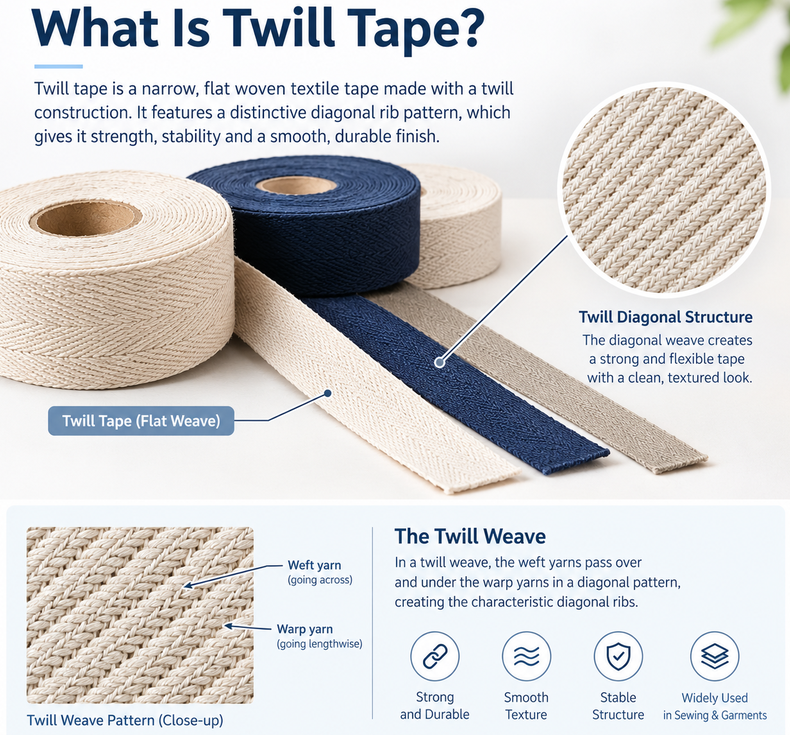
This distinction matters for procurement. Twill describes how the yarns are woven; it does not tell you what fiber the tape is made from. Cotton can be twill-woven, polyester can be twill-woven, and blends can be twill-woven. Twill tape is not the same as cotton tape — twill is a construction, cotton is a fiber.
What Is Twill Tape Used For?
Twill tape is not simply a decorative ribbon. In many applications, its value comes from its woven structure, dimensional stability, and ability to reinforce or finish textile components. The main application categories are:
Garment construction and reinforcement
- Reinforcing seams to prevent stretching and distortion
- Stabilizing necklines and shoulder seams, particularly in knit garments
- Waistband construction and faced waist stabilization
- Hems and edges that require structural support
Ties, closures, and loops
- Apron ties, hospital gown ties, and workwear closures
- Hanging loops, belt loops, and garment loops
- Bag handles and straps
Binding and finishing
- Binding raw fabric edges
- Creating casings for elastic or cording
Non-garment applications
- Tying curtains, cables, and scenery in theatre and event production
- Packaging and transportation of goods
- Craft and DIY projects
What Is Twill Tape Used For in Sewing?
In sewing, twill tape solves specific structural problems. The most common applications are:
Reinforcing Seams
Twill tape is sewn along a seam line to prevent the fabric from stretching, distorting, or failing. This is especially important on seams cut along the stretchiest direction of the fabric.
Stabilizing Necklines and Shoulders
Shoulder seams on knit tops are particularly vulnerable to stretching. Twill tape is added along the shoulder seam to stabilize it — without this, the seam will stretch, sag, or eventually break.
Making Ties and Closures
Twill tape makes sturdy, non-stretching ties for aprons, hospital garments, workwear, and bags. Unlike ribbon, it does not slip or loosen easily.
Creating Loops
Hanging loops, belt loops, and bag loops are commonly made from twill tape because it holds its shape under load.
Binding or Covering Edges
Twill tape can be used for edge finishing, but it is not always the best substitute for bias tape. This is an important distinction that many generic articles overlook.
Twill tape is available from 1/4″ to 2″ wide. It is a very stable, flat tape with little stretch and is a good choice for stabilizing seams or using as a narrow tie or drawstring. Its woven herringbone construction makes cotton twill tape sturdier and stiffer than most fabric tapes.
What Is Cotton Twill Tape?
Cotton twill tape is twill-woven tape made primarily from cotton fibers. It is strong and inert, available in bleached or natural (unbleached) versions. Cotton twill tape is widely used for edging fabrics, tying, strapping, and labeling objects.
What Is Cotton Twill Tape Used For?
Cotton twill tape applications span both consumer and industrial use:
- Garment sewing and seam reinforcement
- Neckline and shoulder stabilization
- Waistband construction
- Apron ties and bag making
- Quilting and home textiles
- Labels, loops, and ties
- Packaging and tying
Why Choose Cotton Twill Tape?
| Property | Cotton Twill Tape |
|---|---|
| Hand feel | Soft and natural |
| Breathability | Good |
| Sewing | Easy to sew; holds shape well |
| Appearance | Matte / natural textile look |
| Dyeability | Good — dyes well with fiber-reactive dyes |
| Tensile strength | High (e.g., ~117 lbs for 1/2″ width in one commercial spec) |
| Sustainability | Natural fiber, but environmental profile depends on cultivation, processing, dyeing, and sourcing |
A common misconception is that “cotton is eco-friendly” as a blanket statement. Cotton is a natural fiber, but the environmental profile of a cotton tape depends on how the cotton was grown, processed, dyed, finished, and sourced. For buyers with sustainability requirements, these factors should be confirmed with the supplier.
Types of Twill Tape
Twill tape is classified along several dimensions that matter for procurement decisions:
By Material
- Cotton twill tape — soft hand, natural appearance, good dyeability
- Polyester twill tape — higher durability, colorfastness, and resistance to stretching
- Cotton/polyester blend — balances hand feel with performance
- Nylon and other fiber options — for specialized applications
By Construction
- Standard twill
- Herringbone twill — the most common visible pattern
- Printed twill tape — for branding, care labels, or promotional use
- Dyed twill tape — stock or custom colors
By Application
- Garment twill tape
- Sewing twill tape
- Binding twill tape
- Tie twill tape
- Industrial twill tape
By Finish
- Natural / unbleached
- Bleached
- Dyed
- Printed with logo or text
Twill Tape vs. Bias Tape: What Is the Difference?
This is one of the most common points of confusion in sewing and garment production. The two products are fundamentally different — but they are sometimes confused because both are narrow fabric strips used in garment construction.
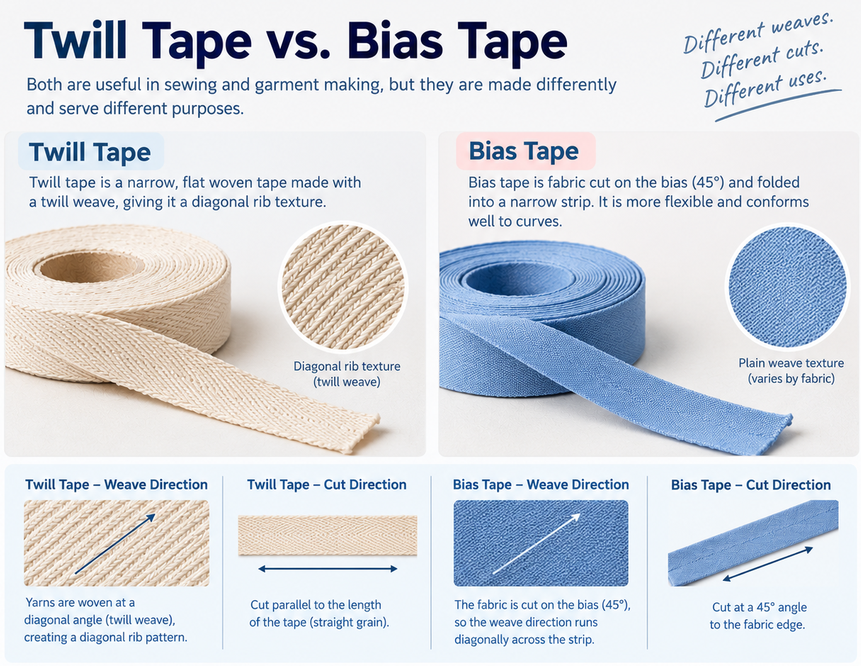
| Feature | Twill Tape | Bias Tape |
|---|---|---|
| Construction | Twill-woven narrow tape | Fabric cut on the bias (diagonal) |
| Surface | Diagonal twill texture | Depends on the fabric used |
| Stretch / flexibility | Minimal stretch; dimensionally stable | Naturally conforms to curves |
| Main purpose | Reinforcement, ties, loops, binding | Edge finishing and binding |
| Curved edges | Less suitable | Very suitable |
| Necklines | Reinforcement | Edge finishing |
| Armholes | Reinforcement | Edge finishing |
| Seams | Excellent for reinforcement | Can finish seams, not reinforce |
| Garment ties | Excellent | Possible but not typical |
The core distinction: Twill tape is defined by its weave, while bias tape is defined by the direction in which the fabric is cut.
This matters practically. Bias tape has natural stretch and flexibility, making it ideal for finishing necklines, armholes, hems, and curved seams. Twill tape has no stretch and is mainly used to stabilize seams and prevent stretching. If you substitute one for the other without understanding the difference, you may get a result that looks right initially but fails in use — a stretched-out neckline, a sagging shoulder seam, or an edge that will not lie flat.
What Can I Use Instead of Twill Tape?
The right substitute depends on why you are using the twill tape, not simply its width. Here is a practical guide organized by application:
| If you use twill tape for… | Possible alternative | Notes |
|---|---|---|
| Seam reinforcement | Selvedge from stable woven fabric; stay tape | Must be non-stretch. Bias tape and rickrack will stretch — avoid. |
| Edge finishing | Bias tape | Bias tape conforms to curves better |
| Ties | Cotton tape; webbing | Choose based on strength requirement |
| Loops | Woven tape; webbing | |
| Decorative trim | Ribbon | Ribbon is thinner and less strong |
| Heavy-duty straps | Webbing |
A key principle from experienced sewists: bias tape and rickrack will stretch and should not be used where the twill tape is meant to provide stabilization. If strength is needed, twill tape or a dense, strong ribbon without stretch should be used.
Twill Tape in Garments: Why Manufacturers Use It
For garment manufacturers, twill tape is not an optional trim — it is a functional component that affects product quality and durability. The main reasons for specifying twill tape in garment production are:
- Stability — prevents seam stretching, especially on shoulder seams, necklines, and waistbands
- Reinforcement — distributes stress at high-wear points such as buttonholes, pocket openings, and closures
- Repeatability — consistent width and construction allow for predictable results across production runs
- Easy sewing — feeds cleanly through industrial machines without curling or distorting
- Bulk supply — available on rolls in standard or custom widths, colors, and lengths
In healthcare, twill tape is used in the making of hospital gowns. In bag manufacturing, it is used for straps and handles. In tailoring, it is used for binding and closure of seams.
How to Choose the Right Twill Tape
Choosing the correct twill tape requires understanding the application first, then working backward to material, width, and construction. Key considerations:
- Application — Is it for reinforcement, binding, ties, or decorative use?
- Material — Cotton for softness and dyeability; polyester for durability and colorfastness; blends for balanced performance
- Width — Wider tape provides more reinforcement but adds bulk
- Stretch requirement — Almost all twill tape is non-stretch, but confirm with the supplier for specific constructions
- Color and finish — Stock colors vs. custom dyeing vs. natural/unbleached
- Compatibility — Will the tape be sewn into a garment that will be washed, dry-cleaned, or exposed to heat?
Twill Tape Specifications Buyers Should Confirm
When sourcing twill tape for production, specify by application first rather than ordering by width alone. A 10 mm cotton twill tape for garment reinforcement can have very different requirements from a 10 mm polyester twill tape used for straps or industrial applications.
| Specification | What to Confirm |
|---|---|
| Material | Cotton, polyester, blend, or other fiber |
| Width | Required finished width (e.g., 6 mm, 10 mm, 12 mm, 15 mm, 20 mm, 25 mm, custom) |
| Thickness / weight | Lightweight vs. heavyweight — critical for garment applications |
| Construction | Standard twill, herringbone, or other weave pattern |
| Color | Stock color, custom-dyed, natural/unbleached, or printed |
| Roll length | 50 m, 100 m, 100 yd, or custom |
| Printing | Logo, care information, or promotional text if applicable |
| Packaging | Roll, spool, or custom packaging |
| Application | Final use — garment, sewing, industrial, packaging, etc. |
Manufacturer’s Note: Don’t specify twill tape by width alone. The same 10 mm width can be produced in different materials, weights, and weave densities, resulting in products with very different performance characteristics. Always share the final application with your supplier before confirming an order.
What Is the HS Code for Twill Tape?
Twill tape does not necessarily have one universal HS code. Classification can depend on the tape’s material, construction, width, and the tariff rules of the importing country.
In some trade classifications, narrow woven textile tapes fall under heading 5806 (narrow woven fabrics, other than goods of heading 5807). Trade data shows twill tape being classified under 5806.31 (narrow woven fabrics of cotton), 5806.32 (of man-made fibres), and 5806.39 (of other textile materials) depending on the fiber content. Certain made-up or industrial textile tapes may appear under other headings such as 5911 or 6217.
Some importers have used codes such as 5806.31.90, 5806.32.90, and 6217.10.00 for twill tape, depending on the specific product and country of import.
Important: Always confirm the classification with your customs broker or the relevant customs authority before importing. HS code classification is product-specific and country-specific — there is no shortcut.
Frequently Asked Questions About Twill Tape
Is twill tape washable?
Yes, most cotton and polyester twill tapes are washable. For dyed or printed versions, confirm care instructions with your supplier, as some dyes may bleed or fade under certain wash conditions.
Does twill tape shrink?
Cotton twill tape may shrink slightly after the first wash unless it is pre-shrunk or specially finished. Polyester twill tape generally has lower shrinkage and better dimensional stability.
What width twill tape should I use for shoulder seams?
10 mm to 15 mm is common for shoulder seam stabilization in garments. The ideal width depends on fabric weight, seam allowance, and the level of reinforcement required.
Can I print my logo on twill tape?
Yes. Printed twill tape is widely used for branding, care labels, and promotional applications. Custom logo printing is available on both cotton and polyester twill tape.
What is the difference between twill tape and webbing?
Webbing is generally thicker, heavier, and stronger than twill tape, making it suitable for load-bearing straps. Twill tape is lighter, flatter, and more commonly used for seam reinforcement, binding, and ties.
Can twill tape be used for outdoor applications?
Polyester twill tape is better suited for outdoor use because it resists moisture, UV degradation, and stretching better than cotton. For prolonged outdoor exposure, confirm UV and weather resistance with your supplier.
How do I choose between cotton and polyester twill tape?
Choose cotton for softness, natural appearance, and dyeability. Choose polyester for durability, colorfastness, and resistance to stretching. Blends offer a balance of both.
Can twill tape be dyed to match fabric?
Cotton twill tape dyes well with fiber-reactive dyes. Polyester twill tape requires disperse dyeing, which is typically done at the manufacturing stage. Custom color matching is available for bulk orders.
What is the minimum order quantity for custom twill tape?
Minimum order quantities vary by material, width, color, and printing requirements. Contact your supplier directly to confirm MOQ for your specific specifications.
How long does custom twill tape production take?
Production lead time depends on order quantity, customization level, and supplier capacity. Standard stock items may ship quickly, while custom-dyed or printed orders typically require additional lead time.