📑 Table of Contents
- Color fastness is the resistance of a dyed textile to fading, color change, or staining when subjected to external factors such as washing, rubbing, light, and perspiration.
- The 5 primary types of color fastness for ribbons are: Laundering, Crocking (Rubbing), Light, Perspiration, and Hot Pressing.
- Color fastness is rated using the Grey Scale (1 to 5), with a commercial requirement of 3.5 – 4 or higher for most apparel and industrial applications.
- Key influencing factors include: fiber-dye compatibility, reduction clearing during dyeing, and the use of fixing agents.
1. Introduction: What Does Color Fastness Mean in Narrow Fabrics?
Color fastness (or colorfastness) is the ability of a dye or pigment to retain its original color on a textile when subjected to external influences such as washing, friction, sunlight, perspiration, or heat. It is one of the most critical quality indicators for dyed textiles.
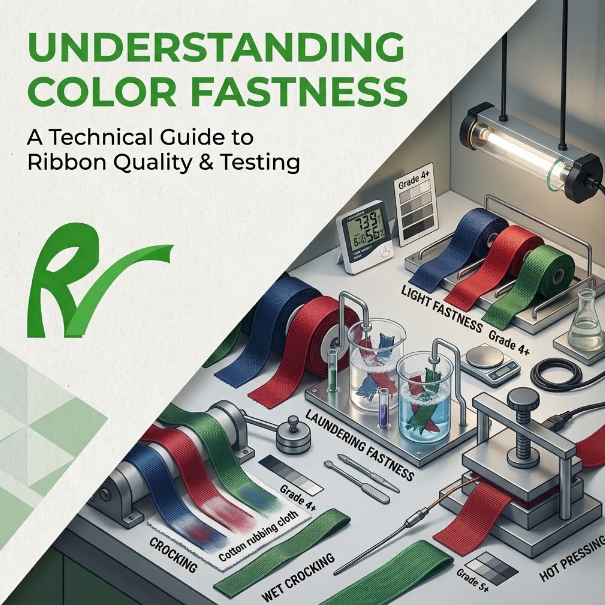
For ribbons, color fastness is particularly crucial. Ribbons are typically used as auxiliary trims attached to high-value garments, luxury gift boxes, or bags. A red ribbed trim that bleeds during washing can ruin an expensive white shirt; a black handle strap that rubs off can stain a consumer’s palm. Poor color fastness in a ribbon often causes more damage to the host product than to the ribbon itself.
This guide provides a technical breakdown of the five key types of color fastness, international testing standards, the underlying process parameters that affect performance, and practical on-site inspection methods for procurement professionals.
2. 5 Critical Types of Color Fastness and Typical Failure Scenarios
2.1 Color Fastness to Laundering
Test Principle: Simulates the effects of temperature, detergent, and mechanical agitation during household or industrial washing.
Failure Scenario: Dye from the ribbon (e.g., neck tape or decorative trim) bleeds out and stains the surrounding fabric (i.e., staining) after the garment is washed. This is one of the most common quality complaints.
2.2 Color Fastness to Crocking (Rubbing – Dry & Wet)
Test Principle: Uses a standard rubbing cloth under controlled pressure to rub against the ribbon surface back and forth (dry and wet), assessing the degree of color transfer.
Failure Scenario: Handle straps on handbags transfer color to the palm during daily use; shoelaces rub against light-colored shoe uppers causing discoloration.
2.3 Color Fastness to Light
Test Principle: Uses a xenon-arc lamp to simulate natural daylight (D65) irradiation, evaluating the color stability of the textile under prolonged light exposure.
Failure Scenario: Satin ribbon gift boxes displayed in shop windows turn yellow or fade over time; outdoor event decorations or curtain tie-backs lighten significantly under direct sunlight.
2.4 Color Fastness to Perspiration
Test Principle: Simulates the corrosive effects of acidic and alkaline human sweat on the dye-fiber bond.
Failure Scenario: Headbands, lanyards, or inner garment ribbons discolor or stain adjacent fabric upon prolonged contact with human skin.
2.5 Color Fastness to Hot Pressing
Test Principle: Evaluates the resistance of the ribbon to discoloration or sublimation under high-temperature ironing or heat-transfer printing. Polyester fibers dyed with disperse dyes are particularly prone to sublimation (dye transitioning from solid to gas state under heat).
Failure Scenario: Satin ribbon changes color during garment finishing due to heat, or the dye sublimates and stains the ironing board and adjacent fabric surfaces.
3. Grading Standards and Testing Methods
3.1 Grey Scale Rating System (1–5)
Color fastness is assessed using the Grey Scale method, where a standard grey scale card is used to visually compare the sample against the standard under controlled lighting.
- Grey Scale for Color Change – evaluates the degree of fading in the tested sample itself.
- Grey Scale for Staining – evaluates the degree of color transfer onto an adjacent white fabric.
The scale includes 5 principal levels: Grade 5 is excellent, Grade 1 is poor. Half-grade increments (e.g., 4-5, 3-4) are also used, providing 9 rating points in practice.
| Grade | Description | Commercial Acceptability |
|---|---|---|
| 5 | No change/staining | Highest level (luxury/high-end) |
| 4-5 | Extremely slight change/staining | Premium quality |
| 4 | Slight change/staining | Typically required for apparel & industry |
| 3-4 | Moderate slight change/staining | Minimum acceptable commercial baseline |
| 3 or below | Noticeable change/staining | Generally not acceptable |
3.2 International Testing Standards
| Fastness Type | ISO Standard (Global/Europe) | AATCC Standard (North America) | GB Standard (China) |
|---|---|---|---|
| Laundering | ISO 105-C06 / C10 | AATCC TM61 | GB/T 3921 |
| Crocking (Rubbing) | ISO 105-X12 | AATCC TM8 | GB/T 3920 |
| Light | ISO 105-B02 | AATCC TM16 | GB/T 8427 |
| Perspiration | ISO 105-E04 | AATCC TM15 | GB/T 3922 |
| Hot Pressing | ISO 105-X11 | AATCC TM133 | GB/T 6152 |
Minimum baseline requirements for general ribbon applications are typically: Laundering ≥3.5 (ISO 105-C01), Crocking ≥3.5 (ISO 105-X12), and Light ≥4 (ISO 105-B02).
4. Underlying Technical Factors Influencing Color Fastness
Color fastness is not determined by a single factor but is the result of interactions between fiber type, dye chemistry, dyeing process parameters, and finishing.
4.1 Fiber-Dye Compatibility
- Polyester: High crystallinity and hydrophobicity; dyed with disperse dyes under high temperature and pressure (approx. 130°C). Disperse dyes bond via Van der Waals forces, offering generally high fastness, especially to light. However, sublimation risk is present under high heat.
- Nylon (Polyamide): Contains reactive functional groups; dyed with acid dyes. Fixation occurs at roughly 100°C via ionic bonding. Nylon ribbons offer brilliant colors but require careful control of wet fastness and light fastness, often necessitating fixing agents.
- Cotton / Silk: Usually dyed with reactive dyes or direct dyes. Reactive dyes form covalent bonds with cellulose fibers, providing good fastness, but require meticulous removal of unfixed surface dye.
4.2 Dyeing Process and Reduction Clearing
Dyeing does not end with color application — the subsequent reduction clearing (or soaping-off) stage critically determines laundering and crocking performance.
A typical continuous dyeing line for polyester ribbon follows: Feed → Pre-wash → Pre-dry → Dye padder → Pre-bake (Infrared) → High-temperature thermosol fixation → Post-wash (Reduction clearing) → Final drying → Winding. Reduction clearing decomposes and removes unfixed, surface-adsorbed dye particles. If this step is insufficient, loose dye molecules will readily transfer during later washing or rubbing, causing staining.
4.3 After-Treatment Fixing Agents
Fixing agents are a vital tool to enhance fastness. For nylon ribbons, acid fixing agents complex with acid dyes to markedly improve washing, perspiration, light, and chlorine fastness. While disperse dyes on polyester are inherently more robust, fixing agents can still be applied for specific high-performance requirements.
5. Practical Quality Inspection Guide for Buyers and Designers
5.1 On-Site Self-Test Methods
For buyers without access to testing labs, these simple methods can provide a preliminary assessment:
- Wet Rubbing Test: Dampen a white cotton cloth, squeeze out excess water, and rub it firmly across the ribbon surface 10–20 times. Check for color transfer on the white cloth.
- Warm Water Immersion: Soak a piece of the ribbon with a white fabric swatch in 40°C water containing a small amount of neutral detergent for 15–30 minutes. Observe any color change in the water or staining of the white fabric.
- Dry Rubbing Test: Wrap a dry white cotton cloth around the ribbon and rub vigorously. Check for dry crocking color transfer.
5.2 Procurement and Development Recommendations
- Verify high-risk colors separately: Deep shades (e.g., red, navy, black) and fluorescent colors inherently have higher color-fastness risks than pastel shades. Request individual test reports for these specific shades.
- Define the end-use clearly: Specify the final application in the product specification sheet (e.g., “suitable for children’s garment washing” vs. “for one-time packaging only”). This allows the supplier to align the appropriate dyeing/finishing standards.
- Demand third-party test reports: For commercial orders, require certified test reports from independent labs such as SGS, Intertek, or TÜV, rather than relying solely on in-house mill test certificates.
- Use a standard light box: Always evaluate color matching and fastness samples under a standard light box with D65 (6500K) illumination to eliminate metamerism and lighting variations.
- Check for sustainability certifications: Certifications like OEKO-TEX Standard 100 not only ensure the safety of dyes but also reflect a disciplined, controlled dyeing process that usually correlates with reliable fastness performance.