Table of Contents
- 1. Introduction
- 2. What Is Ribbon Printing?
- 3. How Is Ribbon Printed?
- 4. Main Ribbon Printing Methods
- 5. Which Method Is Best?
- 6. Which Materials Can Be Printed?
- 7. What Can You Print on Ribbon?
- 8. Applications for Custom Printed Ribbon
- 9. How to Choose the Right Method
- 10. Custom Printed Ribbon Specifications
- 11. FAQ
Introduction
Have you ever wondered how brands get their logos onto ribbons? Or how wedding planners create custom ribbons with names and dates? The answer lies in ribbon printing — the process of applying designs, text, logos, and patterns onto ribbon materials.
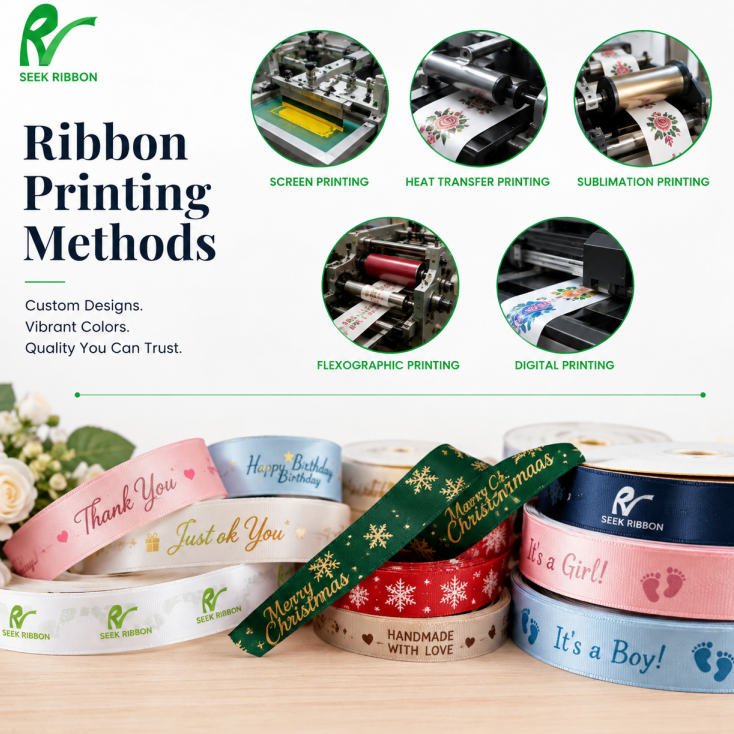
Ribbon printing has become an essential service for businesses across industries. From luxury gift packaging to event decorations, from apparel branding to promotional products, printed ribbons add a level of personalization and professionalism that plain ribbons simply cannot achieve.
In this guide, we’ll cover:
- What ribbon printing is and how it differs from woven ribbons
- The step-by-step ribbon printing process
- Five main printing methods: Screen Printing, Heat Transfer, Sublimation, Flexographic, and Digital Printing
- Which materials can be printed and what you can print on them
- How to choose the right method for your project
- Custom printed ribbon specifications for wholesale buyers
Whether you’re a brand owner looking to order custom printed ribbon, a packaging professional sourcing for retail, or an event planner creating personalized decorations, this guide will help you make informed decisions.
What Is Ribbon Printing?
Ribbon printing is the process of applying ink, dye, or foil onto the surface of a ribbon to create text, logos, patterns, or full-color designs. Unlike woven ribbons, where the design is created by colored threads during the weaving process, printed ribbons have ink applied to the surface after the ribbon is manufactured.
Key Distinction: Printed ribbons offer greater design flexibility, faster production for custom orders, and the ability to print complex, multi-color designs including photographs and gradients. Woven ribbons, by contrast, are more durable and colorfast but limited in design complexity and typically require higher minimum orders.
Printed ribbons are widely used for branding, gift packaging, weddings, events, and promotional products because they can be customized quickly and cost-effectively.
How Is Ribbon Printed?
The ribbon printing process typically follows these steps:
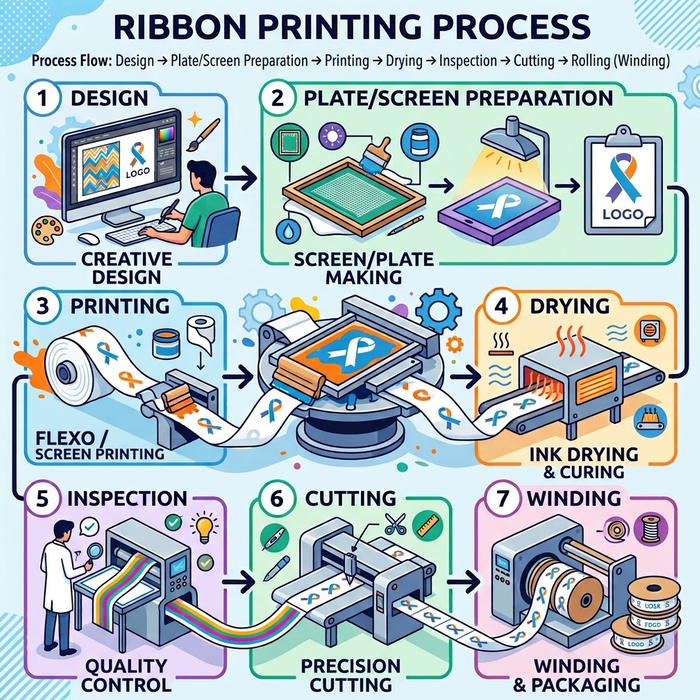
Step 1: Design
The artwork is created or prepared in digital format. This includes logos, text, patterns, or full-color designs. The design is optimized for the chosen printing method — vector files (AI, EPS) for screen printing, high-resolution raster files for digital and sublimation.
Step 2: Plate / Screen / Film Preparation
Depending on the printing method:
- Screen Printing: A stencil (screen) is created for each color in the design.
- Heat Transfer / Sublimation: The design is printed onto special transfer paper using digital printers.
- Flexographic: Photopolymer plates are created for each color.
- Digital: No plates or screens are needed — the design is sent directly to the printer.
Step 3: Printing
The design is applied to the ribbon using the selected printing method. This may involve ink being pushed through a screen (screen printing), heat and pressure transferring dye (sublimation), or direct digital application.
Step 4: Drying / Curing
The printed ribbon passes through a drying or curing process to set the ink. This may involve air drying, heat tunnels, or UV curing depending on the ink type.
Step 5: Inspection
Printed ribbons are inspected for quality — color accuracy, registration, print clarity, and any defects. This step ensures consistency across the entire production run.
Step 6: Cutting & Rolling
The finished printed ribbon is cut to specified lengths and rolled onto spools or wound into bows, ready for packaging and shipping.
Main Ribbon Printing Methods
There are five primary methods for printing on ribbon. Each has its own strengths, ideal applications, and cost structures.
Screen Printing
Screen printing is one of the most traditional and widely used methods for printing on ribbon. It involves creating a stencil (screen) for each color in the design, then forcing ink through the open areas of the screen onto the ribbon.
How It Works
Ink is poured onto one end of the screen, and a squeegee pushes the ink across the screen, forcing it through the mesh openings onto the ribbon below. Each color requires a separate screen, making multi-color designs more complex and costly to set up.
Best For
- Grosgrain ribbon, satin ribbon, cotton ribbon, and polyester ribbon
- Logos, text, and simple patterns
- Single-color or limited-color designs
- Medium to large production runs
Advantages
- Vibrant colors: Ink is applied thickly, resulting in rich, vivid colors with good coverage, even on textured surfaces
- Durable: Screen-printed designs are long-lasting and resistant to wear
- Cost-effective for bulk: Once screens are created, printing is fast and efficient
- Versatile: Works on a wide range of ribbon materials
- Raised print options: Can produce flat or raised (textured) prints
Disadvantages
- Setup cost: Creating screens is time-consuming and expensive, especially for multi-color designs
- Limited color flexibility: Adding or changing colors requires new screens
- Not ideal for small orders: The setup cost makes it less economical for small batches
- Large-area printing can stiffen ribbon: Heavy ink coverage may make the ribbon feel harder
Best Use Case: Screen printing is the go-to choice for logos and text on medium to large orders. If you need 1,000+ yards of ribbon with your brand name or a simple pattern, screen printing offers the best balance of quality and cost.
Heat Transfer Printing
Heat transfer printing involves printing the design onto a special transfer paper using a digital printer, then pressing the paper onto the ribbon using heat and pressure. The heat transfers the ink from the paper to the ribbon.
How It Works
Design → Transfer Paper → Heat Press → Cooling → Finished Ribbon
The design is first printed in full color onto transfer paper. The plain ribbon is aligned with the printed paper and run through a machine that applies heat and pressure. The heat turns the ink into a gas that penetrates and bonds with the ribbon fibers.
Best For
- Complex designs, gradients, and photo-quality images
- Full-color designs with unlimited colors
- Small to medium production runs
- Smooth ribbon surfaces like satin
Advantages
- Excellent color accuracy: Reproduces colors with high precision
- Smooth finish: Prints have a smooth, even appearance
- No screens needed: Lower setup costs than screen printing
- Cost-effective for small runs: Ideal for low minimum orders
- Quick turnaround: Less artwork preparation required
Disadvantages
- Durability concerns: May not be as durable as screen printing, especially with abrasion or washing
- Best on smooth surfaces: May not adhere well to textured ribbons like grosgrain
- Limited to certain materials: Works best on ribbons with some synthetic content
Best Use Case: Heat transfer printing is ideal for complex, multi-color designs on satin ribbons for weddings, events, and luxury packaging.
Sublimation Printing
Sublimation printing is a specialized heat transfer process where dye is turned into a gas (sublimated) and permanently bonded to the ribbon fibers. It is particularly effective on polyester ribbons because the dye bonds with polyester at a molecular level.
How It Works
Design → Transfer Film → Heat Press → Cooling → Finished Ribbon
The design is printed in full color onto a special transfer paper using sublimation inks. The paper is placed against the ribbon and subjected to high heat and pressure. The heat turns the solid dye into a gas, which penetrates the ribbon fibers and bonds with the polyester. When cooled, the dye reverts to a solid, permanently embedded in the ribbon.
Best For
- Polyester ribbons only — the process requires synthetic fibers to bond
- Photographic images, gradients, and highly detailed designs
- Full-color, multi-color designs
- Applications requiring washability and durability
Advantages
- Exceptional detail: Produces photo-quality, highly detailed prints
- Unlimited colors: Full-color designs with no color limitations
- Durable and washable: The dye becomes part of the fiber, making it long-lasting and machine-washable
- No feel: The print has no texture — it’s embedded in the fabric, so the ribbon feels smooth
- Cost-effective for small runs: Lower setup costs than screen printing
Disadvantages
- Polyester-only: Does not work on natural fibers like cotton or silk
- Color limitation on dark ribbons: Best results on white or light-colored ribbons
- Heat sensitivity: Some ribbon materials may be damaged by the high heat required
Best Use Case: Sublimation is the gold standard for full-color, photo-quality designs on polyester ribbons. It’s ideal for intricate patterns, photographic images, and designs requiring exceptional detail and durability.
Flexographic Printing
Flexographic printing (flexo) is a high-speed rotary printing method that uses flexible photopolymer plates to transfer ink onto the ribbon. It’s one of the most efficient methods for large-volume production.
Best For
- Large-volume, bulk production
- Repeating patterns and continuous designs
- Logos, text, and brand labels
- Packaging ribbons and industrial applications
Advantages
- High speed: One of the fastest printing methods, ideal for large runs
- Cost-effective at scale: Per-unit cost decreases significantly with volume
- Multiple colors: Can print up to 6 colors front + 2 colors back in a single pass
- Versatile: Works on a wide range of ribbon materials
- Consistent quality: Excellent for long production runs with consistent results
Disadvantages
- High setup cost: Creating photopolymer plates is expensive
- Not for small orders: Only economical for large volumes
- Limited design complexity: Best for simpler designs and repeating patterns
Best Use Case: Flexographic printing is the choice for high-volume, bulk production of ribbons with repeating patterns or logos. If you need tens of thousands of yards, flexo offers the best cost-efficiency.
Digital Printing
Digital printing is a modern method where the design is printed directly onto the ribbon using digital printers — no plates, screens, or transfer paper required.
Best For
- Small batches and custom orders
- Multi-color designs with unlimited colors
- Personalized and unique designs
- High-detail artwork and photo-realistic images
- Urgent projects requiring quick turnaround
Advantages
- No setup cost: No screens or plates needed — print directly from digital files
- Unlimited colors: Full-color designs with gradients and photo-quality detail
- Quick turnaround: Ideal for urgent projects and small batches
- Low minimum orders: Can print as little as a single roll
- Easy revisions: Colors and designs can be changed instantly
Disadvantages
- Higher per-unit cost: More expensive than screen or flexo for large volumes
- Material limitations: May not work well on textured or ribbed ribbons
- Durability: May be less durable than screen-printed designs for heavy-use applications
Best Use Case: Digital printing is perfect for small-batch, custom orders with complex, multi-color designs. If you need 100 yards of ribbon with a unique design or personalized text, digital printing is your best option.
Which Ribbon Printing Method Is Best?
The following comparison table summarizes the key differences between the five printing methods:
| Printing Method | Best For | Pattern Detail | Color Options | Small Orders | Bulk Orders |
|---|---|---|---|---|---|
| Screen Printing | Logos & Text | Medium | Good | ✓ | ✓ |
| Heat Transfer | Detailed Designs | High | Excellent | ✓ | ✓ |
| Sublimation | Polyester Ribbon | Very High | Excellent | ✓ | ✓ |
| Flexographic | Repeating Designs | Medium | Good | — | ✓ |
| Digital Printing | Custom Designs | Very High | Excellent | ✓ | ✓ |
Which Ribbon Materials Can Be Printed?
Different ribbon materials respond differently to various printing methods. Here’s a breakdown of common printed ribbon materials:
Grosgrain Ribbon
Textured with fine horizontal ribs. Best printed with screen printing (the texture helps grip the ink) or flexographic for bulk orders. Heat transfer and digital may not adhere well to textured surfaces.
Satin Ribbon
Smooth, lustrous, and elegant. Works well with all printing methods — screen, heat transfer, sublimation, flexo, and digital. Heat transfer and sublimation produce particularly smooth, high-quality results on satin.
Organza Ribbon
Sheer and lightweight. Best printed with screen printing or digital printing. The sheer nature of organza requires careful ink selection to maintain transparency.
Cotton Ribbon
Natural, matte finish. Works best with screen printing using water-based inks. Sublimation does not work on 100% cotton.
Velvet Ribbon
Soft, plush texture. Best printed with screen printing or foil stamping. The pile texture can make detailed printing challenging.
Polyester Ribbon
Synthetic, durable, colorfast. Sublimation printing is specifically designed for polyester and produces the best results. Also works with screen, heat transfer, flexo, and digital.
Material Note: The choice of printing method should always consider the ribbon material. Sublimation requires polyester, screen printing works on almost everything, and heat transfer prefers smooth surfaces.
What Can You Print on Ribbon?
Custom printed ribbons can feature virtually any design. Common printed elements include:
Custom Printed Ribbon for Different Applications
Custom printed ribbons serve a wide range of B2B applications:
How to Choose the Right Ribbon Printing Method
Selecting the right printing method requires evaluating several factors. Here’s a decision-making framework for procurement professionals:
1. Material
What ribbon material are you using? Sublimation requires polyester. Screen printing works on almost everything. Heat transfer prefers smooth surfaces like satin.
2. Ribbon Width
Narrow ribbons (under 1 inch) may be challenging for some printing methods. Digital and flexo handle narrow widths well. Screen printing works best on wider ribbons.
3. Artwork Complexity
Simple logos and text? Screen printing is cost-effective. Complex, multi-color designs with gradients? Sublimation or digital are better choices.
4. Number of Colors
Limited colors (1-3)? Screen printing works well. Unlimited colors? Digital, sublimation, or heat transfer are required.
5. Order Quantity
Small batch (under 1,000 yards)? Digital or heat transfer. Medium run (1,000-10,000 yards)? Screen printing. Large volume (10,000+ yards)? Flexographic.
6. Durability Requirements
Need washable, long-lasting prints? Sublimation on polyester. Decorative, non-washable applications? Screen printing, heat transfer, or digital all work.
7. Budget
Consider both setup costs and per-unit costs. Digital has low setup but higher per-unit cost. Screen and flexo have higher setup but lower per-unit cost at volume.
Custom Printed Ribbon Specifications
When ordering custom printed ribbon from a manufacturer like Seek Ribbon, consider these specification parameters:
Frequently Asked Questions About Ribbon Printing
Yes. Logos can be printed on ribbon using screen printing, heat transfer, sublimation, flexographic, or digital printing. The best method depends on your order quantity, material, and design complexity.
There is no single “best” method — it depends on your needs. Screen printing is best for logos and text in bulk. Sublimation is best for full-color, photo-quality designs on polyester. Digital is best for small batches and custom orders.
Yes. Grosgrain ribbon can be printed using screen printing or flexographic printing. The textured surface helps grip the ink. Heat transfer and digital may not adhere well to the textured surface.
Yes. Satin ribbon works well with all printing methods — screen, heat transfer, sublimation, flexo, and digital. Its smooth surface produces excellent print quality.
Yes. Polyester ribbon is the ideal substrate for sublimation printing, which produces durable, washable, photo-quality prints. Polyester also works with screen, heat transfer, flexo, and digital printing.
Cost depends on material, width, printing method, order quantity, number of colors, and design complexity. Digital and heat transfer have lower setup costs but higher per-unit costs. Screen and flexo have higher setup costs but lower per-unit costs at volume.
Production time varies by method and order size. Digital printing can be as fast as 3-5 days for small orders. Screen printing and flexo typically require 7-14 days due to screen/plate creation.
Printed ribbon has ink applied to the surface after manufacturing. Woven ribbon has designs created by colored threads during the weaving process. Printed ribbon offers greater design flexibility and lower minimums; woven ribbon is more durable and colorfast.
Conclusion
Ribbon printing transforms plain ribbons into powerful branding tools, elegant packaging accents, and personalized decorations. Whether you choose screen printing for bold logos, sublimation for photo-quality designs, or digital printing for small-batch customization, understanding the strengths and limitations of each method ensures you get the best results for your project.
From satin to grosgrain, from simple text to full-color artwork — the right printing method brings your vision to life on ribbon.
Ready to create custom printed ribbon for your brand? Choose the method that fits your needs — and make every ribbon tell your story.