📑 Table of Contents
1. Introduction
If you export or import ribbons, you’ve likely encountered the terms HS Code, HSN Code, and GST Rate. But here’s the challenge: “ribbon” isn’t a single product with a single code. The correct classification depends entirely on what your ribbon is made of, how it’s constructed, and what it’s used for.
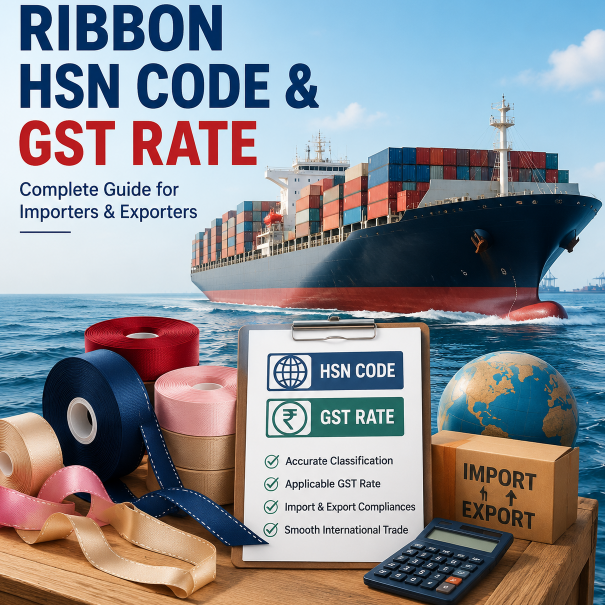
This guide cuts through the confusion, providing a comprehensive, expert-driven breakdown of ribbon HS codes, HSN codes, and GST rates across different materials and applications. Whether you’re shipping satin craft ribbons, elastic webbing, or decorative trimmings, you’ll walk away with the precise codes you need for compliant international trade.
2. What Are HS Codes, HSN Codes, and GST Rates?
Before we dive into specific classifications, let’s clarify the terminology:
- HS Code (Harmonized System Code): A six-digit international product classification system developed by the World Customs Organization (WCO). Used by over 200 countries for customs tariffs and trade statistics. The first six digits are harmonized globally; additional digits (up to 10) are country-specific.
- HSN Code (Harmonized System of Nomenclature): India’s adoption of the HS system, used for both customs and GST classification. It follows the same six-digit structure as the global HS.
- GST Rate (Goods and Services Tax): India’s domestic consumption tax applied to goods, varying by product category. For imported goods, IGST (Integrated GST) is levied at the time of import.
3. Primary Ribbon Classifications: HS Code Chapter 5806
Most textile ribbons—woven, narrow fabrics used for decoration, apparel, packaging, and crafts—fall under HS Code Chapter 5806: Narrow woven fabrics, other than goods of heading 5807.
Within Chapter 5806, ribbons are classified by:
- Fiber composition (cotton, man-made fibers, silk, etc.)
- Width (typically ≤ 30 cm)
- Construction (woven vs. warp-without-weft adhesive fabrics)
- Presence of elastomeric yarn or rubber thread
3.1 Polyester & Other Man-Made Fiber Ribbons
HS Code 5806.32 covers narrow woven fabrics of man-made fibers, other than those containing elastomeric yarn.
| Product Type | HS Code (6-digit) | Typical GST Rate (India) |
|---|---|---|
| Polyester woven ribbons (width ≤ 12 cm) | 5806.32 | 5% |
| Nylon woven ribbons | 5806.32 | 5% |
| Satin ribbons (100% polyester) | 5806.32 | 5% |
| Polyester ribbons with woven selvedge | 5806.32.1030 (US) | Varies by country |
| Nylon ribbons with wire in selvedge | 5806.32.1050 (US) | Varies by country |
3.2 Cotton Ribbons
HS Code 5806.31 covers narrow woven fabrics of cotton.
| Product Type | HS Code (6-digit) | Typical GST Rate (India) |
|---|---|---|
| Cotton woven ribbons | 5806.31 | 5% |
| Typewriter ribbon cloth (cotton) | 5806.31.10 | 5% |
| Unbleached cotton ribbons | 5806.31 | Varies by country |
Note: In China’s customs classification, 5806310000 applies to narrow woven fabrics of cotton, requiring declaration of weaving method, composition, and width.
3.3 Silk & Specialty Fiber Ribbons
HS Code 5806.39 covers other narrow woven fabrics of silk, silk waste, or other textile materials not elsewhere specified.
| Product Type | HS Code (6-digit) | Typical GST Rate (India) |
|---|---|---|
| Silk ribbon (≥85% silk by weight) | 5806.39 | 5% |
| Metallic ribbon | 5806.39 | 5% |
3.4 Elastic Ribbons (with Elastomeric Yarn or Rubber)
HS Code 5806.20 covers narrow woven fabrics containing 5% or more by weight of elastomeric yarn or rubber thread.
| Product Type | HS Code (6-digit) | Typical GST Rate (India) |
|---|---|---|
| Elastic woven ribbons (≥5% elastomer) | 5806.20 | 5% |
| Nylon elastic ribbon (90% nylon, 10% elastic) | 5806.20 | 5% |
3.5 Velvet & Pile Ribbons
HS Code 5806.10 covers narrow woven pile fabrics, including velvet ribbons.
4. Ornamental Trimmings & Decorative Ribbons
HS Code 5808 covers braids in the piece and ornamental trimmings, including tassels, pompons, and similar articles.
| Product Type | HS Code | IGST Rate (India) | BCD (India) |
|---|---|---|---|
| Rayon ribbons with ornamental trimmings | 5808.9040 | 5% | 10% |
| Other ornamental trimmings | 5808.90 | 5% | 10% |
5. Special Category: Plastic Gift-Wrapping Ribbons
Not all “ribbons” are textile fabrics. Some are classified in entirely different chapters based on their material and function.
HS Code 3920.20 covers strips of polypropylene plastics used as decorative or gift-wrapping ribbon.
| Product Type | HS Code | Notes |
|---|---|---|
| Polypropylene gift ribbon | 3920.20.0015 (US) | Classified as plastic strip, not textile |
| Plastic decorative ribbon | 3920.20 / 3920.30 | Various plastic types |
6. Ribbon HS Code Quick Reference Table
| Ribbon Type | Primary HS Code (6-digit) | India GST Rate |
|---|---|---|
| Polyester woven ribbon | 5806.32 | 5% |
| Nylon woven ribbon | 5806.32 | 5% |
| Satin ribbon | 5806.32 | 5% |
| Cotton woven ribbon | 5806.31 | 5% |
| Elastic ribbon (≥5% elastomer) | 5806.20 | 5% |
| Velvet ribbon | 5806.10 | 5% |
| Silk ribbon | 5806.39 | 5% |
| Rayon ornamental ribbon | 5808.9040 | 5% |
| Metallic ribbon | 5806.39 | 5% |
| Plastic gift ribbon | 3920.20 | Varies by country |
7. Key Compliance Considerations for Exporters
1. Width Matters
Most textile ribbons under Chapter 5806 are defined as narrow fabrics with a width not exceeding 30 cm. If your ribbon exceeds this width, it may be classified under broader woven fabric headings (Chapter 52-55).
2. Composition Determines Classification
For man-made fiber ribbons under 5806.32, classification depends on which fiber predominates by weight. Always test and document fiber composition accurately.
3. Country-Specific Extensions
The six-digit HS code is globally harmonized, but countries add their own digits:
- US: 10-digit HTSUS codes (e.g., 5806.32.1080)
- India: 8-digit ITC-HS codes (e.g., 58089040)
- China: 10-digit HS codes (e.g., 5806320000)
Always verify the full country-specific code for your destination market.
4. GST Rate Verification
India’s GST rates on ribbons are predominantly 5% for textile ribbons under Chapter 58. However:
- Some items may have varying rates based on specific subheadings
- Always verify against the latest CBIC notification
5. Documentation Requirements
For textile ribbons imported into India, PSIC (Pre-Shipment Inspection Certificate) from an accredited lab in the exporting country may be required. Imports from the EU, Serbia, Poland, Denmark, China, Australia, Canada, Japan, and South Korea are exempted from azo dye testing.
8. Final Expert Takeaway
🧠 Expert Recommendation:
Selecting the correct HS/HSN code for ribbons isn’t just about compliance—it directly impacts your duty costs, shipping timelines, and customer satisfaction. A misclassification can result in:
- Delayed customs clearance
- Penalties and fines
- Higher than expected duty costs
- Loss of preferential tariff benefits
Our recommendation: Work with a licensed customs broker or freight forwarder to verify classifications for your specific products. Provide them with:
- Fiber composition (percentage by weight)
- Width in centimeters
- Construction method (woven, knitted, braided, adhesive)
- Intended use (decoration, apparel, industrial, etc.)
- Packaging type (spools, cartons, rolls, pieces)
With accurate classification, you’ll navigate international trade smoothly, minimize costs, and avoid compliance headaches.
Disclaimer: This guide is for informational purposes only and does not constitute legal or tax advice. Tariffs, duties, and GST rates are subject to change. Always consult with qualified professionals and verify current rates with official customs authorities before shipping.